Planning a tiger safari trip from the Pink City and wondering exactly how far Ranthambore is from Jaipur, and how best to get there? You’re not alone — this is one of the most common questions Rajasthan travelers ask, because Ranthambore National Park is usually visited as a side trip from Jaipur rather than a standalone destination.
The short answer: Jaipur to Ranthambore is approximately 160–180 km by road, and the drive takes around 3 to 4 hours depending on the exact route and traffic. But the full answer — which route to take, whether to go by train or car, what it costs, where to stop on the way, and where to stay once you arrive — takes a bit more explaining. That’s what this guide covers, in full detail, so you don’t have to piece it together from ten different websites.
Jaipur to Ranthambore Distance: Quick Overview
| Mode of Travel | Distance | Travel Time | Nearest Access Point |
|---|---|---|---|
| By Road (car/taxi) | 160–180 km | 3–4 hours | Direct to Ranthambore/Sawai Madhopur town |
| By Train | ~125–145 km (rail distance) | 2–4 hours | Sawai Madhopur Railway Station (10 km from the park) |
| By Air | ~130 km (aerial distance) | Fly to Jaipur, then drive | Jaipur International Airport (nearest usable airport) |
A quick note on why you’ll see different numbers on different websites: the distance genuinely varies by 15–30 km depending on which route you drive (via Tonk, via Dausa-Lalsot, or via the Delhi-Mumbai Expressway/NE-4), and whether the source is measuring straight-line (“as the crow flies”) distance or actual road distance. Straight-line distance between the two cities is close to 120 km, but no road runs in a straight line — so 160–180 km by road is the number to plan around.
Distance Between Jaipur and Ranthambore by Road
Ranthambore National Park itself lies near the town of Sawai Madhopur, in southeastern Rajasthan. Jaipur to Ranthambore (or more precisely, Jaipur to Sawai Madhopur, since the park entrance and most hotels sit around this town) covers 160 to 180 km, and the drive typically takes 3.5 to 4 hours in a private car, longer if you’re stopping along the way or traveling in a bus.
Best Routes by Road
There are two main road routes connecting the two cities:
1. Jaipur → Tonk → Sawai Madhopur → Ranthambore (via NH52/NE-4) This is the most commonly recommended route. It runs through Tonk, a historic town, and generally has smoother, better-maintained roads with fewer bottlenecks. Most private taxis and tour operators default to this route because it’s a few minutes faster and has better highway infrastructure.
- Jaipur to Tonk: ~95–100 km (broad highway, multiple fuel stops and dhabas)
- Tonk to Sawai Madhopur: ~70–80 km (mix of highway and state road)
- Sawai Madhopur to Ranthambore National Park gate: ~10–13 km
2. Jaipur → Dausa → Lalsot → Sawai Madhopur → Ranthambore (via NH21) This route runs through Dausa and Lalsot and is a reasonable alternative, though a few stretches near Lalsot can be narrower and busier with local traffic. It’s marginally longer for most travelers and less preferred unless you’re coming from the Agra/Delhi side, where this road naturally connects.
Which route should you pick? If you’re driving from Jaipur city itself, go via Tonk — it’s faster, has better road quality, and more amenities en route. If you’re combining Ranthambore with Agra or Delhi on a Golden Triangle-style itinerary, the Dausa-Lalsot road may fit your route better depending on your starting point.
Road Condition
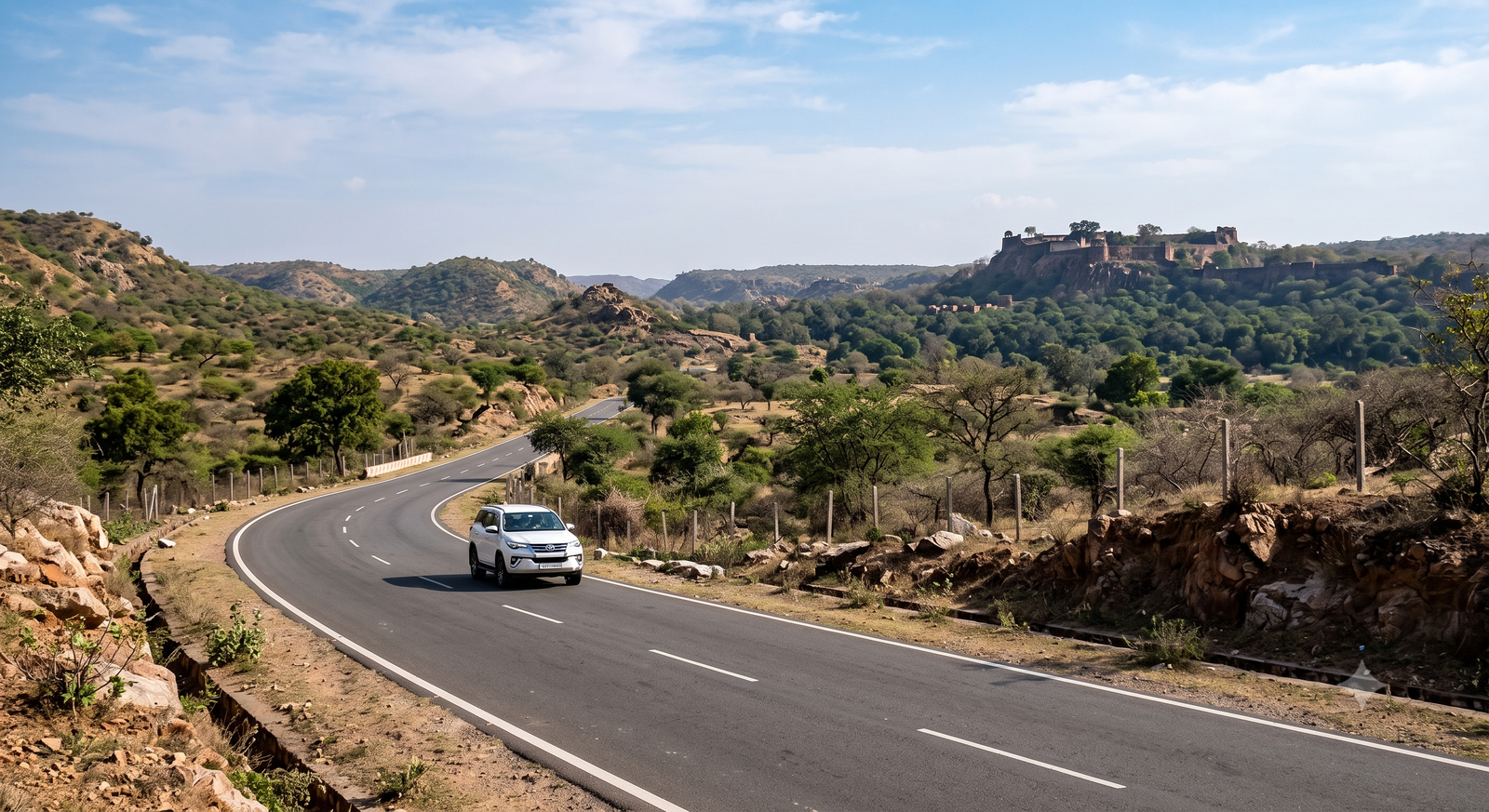
The highways connecting Jaipur and Ranthambore are largely in good shape — a mix of four-lane national highway and decent state highway. A few patches near Tonk and closer to Sawai Madhopur town can have potholes or ongoing repair work, so budget a little extra time, especially during or right after monsoon season (July–September). Night driving isn’t recommended on this stretch due to limited lighting in rural patches and occasional livestock or wildlife crossing the road near the reserve.
Distance Between Jaipur and Ranthambore by Train
If you’d rather skip the driving altogether, the train is genuinely the most comfortable and time-efficient way to travel this route — and it’s the option most seasoned Rajasthan travelers actually recommend.
Sawai Madhopur Junction (station code SWM) is the railway station serving Ranthambore, and it’s a major stop on the Delhi–Mumbai main line, which means it’s well connected with frequent daily trains.
Key facts about the Jaipur–Sawai Madhopur train route:
- Distance covered by rail: roughly 125–145 km, depending on the specific train’s route
- Journey time: most trains cover this in 2 to 2.5 hours; a couple of slower passenger trains take up to 3.5–4 hours
- Frequency: trains run through this corridor almost every 1–2 hours across the day, since it’s part of the busy Delhi–Mumbai trunk route
- Popular trains on this route include the Ranthambore Express, the Jaipur SF Express, the Kota–Sawai Madhopur–Jaipur Intercity Express, and various daily superfast/express trains that happen to pass through both stations
- Where to board: In Jaipur, trains depart from Jaipur Junction (JP), the city’s main railway station, well connected by road and the Jaipur Metro’s Pink Line. Some trains also stop at Durgapura station on the city’s outskirts.
- Where you arrive: Sawai Madhopur Junction, which is about 10 km from Ranthambore National Park’s core zone and close to most hotels in the area.
Ticket classes and rough fares (per person, one-way):
- General/Sleeper (non-AC): ₹100–200
- AC Chair Car / 3AC: ₹250–550
- 2AC / 1AC: ₹550–1,200
Most travelers going for a day trip or short getaway find a morning train from Jaipur works well, letting you reach Sawai Madhopur in time for a same-day or next-morning safari. Book tickets in advance through IRCTC, especially during peak tourist season (November–February), as popular trains fill up quickly.
Distance Between Jaipur and Ranthambore by Air
There’s no operational commercial airport directly at Ranthambore or Sawai Madhopur for regular passenger flights. So “by air” really means: fly into Jaipur International Airport, then travel onward by road or rail.
- Aerial (straight-line) distance: approximately 120–130 km
- Nearest functioning airport to Ranthambore: Jaipur International Airport (Sanganer)
- Onward journey: By taxi (3–4 hours) or by train from Jaipur Junction to Sawai Madhopur (2–2.5 hours)
If you’re flying in from another Indian city or internationally, Jaipur Airport is your entry point — there is no practical benefit to searching for closer airstrips, as none offer regular commercial service.
Jaipur Airport to Ranthambore: Travel Information
Once you land at Jaipur Airport, you have two realistic options to reach Ranthambore:
- Direct taxi from the airport: Pre-book a cab that picks you up straight from arrivals and drives you the full 175–190 km to Ranthambore. This takes roughly 4 hours including the drive from the airport to the highway, and is the most convenient (if priciest) option, especially with luggage or a family in tow.
- Airport → Jaipur Junction → train to Sawai Madhopur: Take a cab or app-based ride from the airport to Jaipur Junction railway station (about 20–25 minutes), then catch a train onward. This works well if your flight lands with enough buffer before a train departure, and it’s usually cheaper and faster than a direct road transfer.
Many travelers combine the two: fly into Jaipur, spend a day or two sightseeing in the city, then take the train onward to Ranthambore — which is genuinely the most efficient way to see both destinations without excessive road time.
Jaipur to Ranthambore Taxi and Cab Options
Private taxis are the most flexible way to travel this route, especially if you’re traveling with family, have heavy luggage, want to stop at points of interest along the way, or are catching an early-morning safari and want a fixed pickup time.
What to expect:
- Vehicle types: Sedans (Dzire, Etios) for 2–3 people; SUVs (Innova, Ertiga) for 4–6 people; Tempo Travellers for larger groups
- One-way fare: approximately ₹2,500–₹4,000 for a sedan, ₹3,500–₹5,500 for an SUV
- Round-trip fare: approximately ₹4,500–₹7,000 depending on vehicle type, whether the driver waits at Ranthambore, and number of days
- Journey time: 3.5–4 hours one-way, plus stops
Most local operators and cab aggregators in Jaipur offer this as a standard route, so you’ll find plenty of options — from oneway drop cabs to full-day hires with a waiting driver. If you’re booking a multi-day Ranthambore trip, it’s often more economical to hire the cab for a round trip with waiting time included, rather than booking separate one-way trips.
Tip: Confirm whether the quoted fare includes tolls, parking, and driver allowance (bata) for overnight stays — these are commonly charged extra and can add ₹500–₹1,000 to your total.
Jaipur to Ranthambore Bus Options
Buses are the most budget-friendly way to make this trip, though they’re also the slowest and least comfortable of the three main options.
- Operators: Rajasthan State Road Transport Corporation (RSRTC) runs government buses on this corridor, and several private bus operators also ply the route
- Journey time: approximately 4–5.5 hours, sometimes longer depending on stops and road conditions
- Fare: roughly ₹150–350 for non-AC buses; ₹350–600 for AC/Volvo-type services where available
- Route detail: Some RSRTC buses travel via Bonli (around 45 km from Sawai Madhopur) or via Khilchipur (about 11 km away), meaning you may need a short local taxi or auto-rickshaw to complete the final stretch into Sawai Madhopur or the park area
- Boarding point: Sindhi Camp Bus Stand (Jaipur’s main interstate bus terminal) is the usual departure point
Buses make sense if you’re traveling solo on a tight budget and don’t mind a longer, less predictable journey. For families, first-time visitors, or anyone catching a specific safari slot, trains or taxis are the more practical choice.
Nearest Railway Station and Airport to Ranthambore
- Nearest railway station: Sawai Madhopur Junction (SWM) — about 10–13 km from Ranthambore National Park and most of the resorts/hotels in the area. This is by far the most convenient station and the one nearly all visitors use.
- Nearest airport: Jaipur International Airport — around 160–180 km away by road. There is no active commercial airport closer to Ranthambore, so Jaipur remains the gateway airport for the region.
Best Time to Travel from Jaipur to Ranthambore
Ranthambore National Park is open from October to June and closed during the monsoon months (July to September) for the safety of wildlife and to allow the ecosystem to recover.
- October–February: Pleasant, cool weather — the most comfortable time for the road trip and for sightseeing along the way. Winter mornings can get foggy, so early starts may involve slower driving.
- March–June: Hotter, especially by May–June, but this period offers the best tiger sighting chances, since animals gather more visibly around dwindling water sources. If you’re prioritizing wildlife photography over comfort, this window is worth considering despite the heat.
- July–September: The park is shut, so this isn’t a viable travel window for a Ranthambore safari trip at all.
If comfort matters as much as sightings, November to February is the sweet spot most travelers choose. If tiger sightings are your top priority, aim for April to June, and travel early morning or evening to avoid the peak afternoon heat on the road.
Estimated Travel Costs: Road vs Train vs Taxi vs Bus
Here’s a side-by-side look at what you can expect to spend, per person unless noted otherwise:
| Mode | Approx. Cost (one-way, per person) | Approx. Time |
|---|---|---|
| Bus (non-AC) | ₹150–350 | 4–5.5 hours |
| Bus (AC/Volvo) | ₹350–600 | 4–5 hours |
| Train (Sleeper/General) | ₹100–200 | 2–3.5 hours |
| Train (AC Chair Car/3AC) | ₹250–550 | 2–2.5 hours |
| Shared/private taxi (per vehicle, not per person) | ₹2,500–5,500 one-way | 3.5–4 hours |
| Self-drive (fuel cost estimate) | ₹1,200–1,800 in fuel (car) | 3.5–4 hours |
For a family of four or a small group, a private taxi often works out to roughly the same per-person cost as train AC classes, while offering far more flexibility — door-to-door pickup, luggage space, and the ability to stop wherever you like.
Private Taxi vs Bus vs Train: Which Should You Choose?
| Factor | Private Taxi | Train | Bus |
|---|---|---|---|
| Comfort | High | High (AC classes) | Low to moderate |
| Flexibility | Very high — stop anywhere, set your own timing | Fixed schedule | Fixed schedule, more stops |
| Speed | 3.5–4 hrs | 2–2.5 hrs (fastest overall) | 4–5.5 hrs (slowest) |
| Cost (for a family) | Moderate to high | Low to moderate | Lowest |
| Best for | Families, couples wanting privacy, those with luggage, early safari pickups | Solo travelers, couples, budget-conscious travelers wanting speed | Solo backpackers on a tight budget |
| Booking effort | Easy, book on demand | Needs advance booking in peak season | Easiest, frequent departures |
Our take: If your budget allows it, a private taxi is the most practical choice for most travelers — particularly if you’re catching a specific safari time slot, traveling with kids or elderly family members, or want to explore Tonk and other stops en route. If you’re traveling solo or as a couple and want the fastest, most comfortable no-fuss option, the train wins hands down for this particular route, since Sawai Madhopur station sits close to the park. Buses are best reserved for genuinely tight budgets where time isn’t a major constraint.
Important Places and Attractions Along the Route
The Jaipur–Ranthambore drive isn’t just a transit stretch — a few worthwhile stops can turn it into part of the trip itself:
- Chandlai Lake — A quiet spot around 30 km from Jaipur, popular with birdwatchers, especially in winter when migratory birds arrive.
- Bisalpur Dam — A scenic detour offering wide reservoir views; a good stretch-your-legs stop if you’re not in a rush.
- Tonk — A historic town with Nawabi-era architecture, old mosques, and mansions, roughly the midpoint of the Tonk route. Worth a short stop for photography or a quick bite.
- Rameshwaram Dham (near Uniara) — A regional temple site with notable architecture, a good option for travelers wanting a short cultural or spiritual halt.
- Sawai Madhopur town — Before entering the park zone, the town itself has local markets and a real sense of small-town Rajasthan worth a brief look.
Recommended Restaurants and Hotels on the Way
Given the journey is only 3–4 hours, most travelers don’t need an overnight halt, but a food stop is common and genuinely useful for breaking up the drive:
- Highway dhabas near Tonk are popular for hot, fresh Rajasthani thalis, parathas, and chai — a reliable stop most private drivers already know well.
- Multiple fuel-station food courts along NH52 offer basic but decent food, clean restrooms, and parking — useful if you’re traveling with children.
- If you prefer a sit-down meal with better hygiene standards, plan your stop in Tonk town itself, where a handful of proper restaurants operate alongside the roadside dhabas.
For a day trip with no overnight stop needed, timing your meal break to coincide with the midpoint of the drive (around Tonk) works best — you avoid rushing and still make good time to your hotel or the park gate.
Best Hotels and Resorts Near Ranthambore
Ranthambore has a well-developed range of accommodation, mostly concentrated along the Ranthambore Road between Sawai Madhopur town and the park gates. Broadly, options fall into these categories:
- Luxury resorts and heritage properties: Several high-end wildlife resorts here offer jungle-lodge style luxury, private pools, and curated safari experiences — ideal for travelers wanting a premium stay to match the wildlife experience.
- Mid-range hotels and resorts: A large number of comfortable, well-reviewed 3–4 star resorts sit along Ranthambore Road, offering good value with amenities like restaurants, pools, and safari-booking assistance.
- Budget guesthouses and homestays: Closer to Sawai Madhopur town, simpler stays suit backpackers and travelers prioritizing cost over comfort.
When booking, prioritize properties located along Ranthambore Road (rather than deep inside Sawai Madhopur town) since they cut down transfer time to the safari gates significantly — some are just 5–10 minutes from the entry zones, which matters a lot given how early morning safaris start.
For a curated look at stay options near the park gates, see the Hotels & Stays guide on Ranthambhore Park, which lists properties by proximity to the safari zones.
How to Reach Ranthambore National Park from Jaipur
Putting it all together, here’s the simplest way to think about your journey:
- Decide your mode: Train (fastest, most comfortable for the money) or private taxi (most flexible, best for families).
- Time it around your safari: Ranthambore’s safari slots run early morning and late afternoon, so plan your arrival the evening before if you want to catch a morning safari the next day.
- Book your stay near Ranthambore Road: This minimizes transfer time between your hotel and the park gates.
- Arrange local transfer: From Sawai Madhopur station, a short taxi or auto-rickshaw ride (10–15 minutes) gets you to most hotels.
- Pre-book your safari permits: Ranthambore uses a permit system through the Rajasthan Forest Department, and slots — especially for popular zones — fill up fast in peak season, so book well ahead. For current entry and permit pricing, check this complete Ranthambore entry fee guide before you finalize your budget.
How Much Time Is Required for a Ranthambore Trip?
- Minimum for a proper visit: 2 days, 1 night — enough for one evening and one morning safari, which meaningfully improves your odds of a tiger sighting compared to a single safari.
- Comfortable trip: 3 days, 2 nights — allows two to three safaris across different zones, plus time to see Ranthambore Fort and relax at your resort.
- Day trip from Jaipur: Technically possible (drive in early morning, do an afternoon safari, drive back or stay one night), but it’s a rushed itinerary and not recommended if you can avoid it, given the total driving time involved.
Most travel planners recommend at least one overnight stay to make the trip worthwhile — cramming it into a single day means a lot of time on the road relative to time actually spent in the park.
Travel Tips for First-Time Visitors
- Book safaris in advance, ideally a few weeks ahead in peak season (November–February) and even earlier during the popular April–June sighting season.
- Carry cash in smaller denominations for local transport, tips, and roadside stops, as card acceptance can be patchy in rural stretches.
- Dress in neutral colors (khaki, olive, beige) for safaris — bright colors can spook wildlife and stand out unnecessarily.
- Start early for both the road journey and the safari itself — Ranthambore’s morning safaris begin very early, often before sunrise.
- Keep a buffer day if wildlife sightings matter to you; tiger sightings are never guaranteed on a single safari.
- Check park closure days — Ranthambore is typically closed on certain days or zones rotate, so confirm before finalizing your safari booking.
Useful Information for Families, Couples, and International Tourists
For families: Choose a private taxi over bus or general train class for comfort with children. Opt for resorts with pools and family rooms, and pick canter safaris (larger, more affordable, shared vehicles) if traveling with a larger group, or jeep safaris (smaller, more exclusive, six-seaters) for a quieter experience with younger kids who may need more space.
For couples: Many resorts near Ranthambore offer romantic packages, private dining, and luxury tents — worth researching if you’re planning an anniversary or honeymoon-style trip. The train journey (versus a long taxi ride) can also be a scenic, relaxed way to travel together.
For international tourists: Carry a printed or digital copy of your safari booking confirmation and ID, as these are checked at park entry. If unfamiliar with Indian train booking systems, consider booking through a travel agent or asking your hotel to arrange transfers — it removes a layer of complexity from an otherwise straightforward trip. Also budget extra time for language or communication differences at smaller roadside stops, though most tourist-facing services along this route are used to international visitors.
Common Mistakes Travelers Should Avoid
- Not booking safari permits in advance — This is the single biggest mistake; permits for popular zones sell out, especially in peak season.
- Underestimating travel time — 3–4 hours can stretch longer with traffic, road work, or stops, so don’t cut it too close to a scheduled safari.
- Choosing a hotel far from Ranthambore Road — Staying deep in Sawai Madhopur town adds unnecessary transfer time before early safaris.
- Skipping a night’s stay to save time — A rushed day trip usually means only one safari and a lot of driving, which most visitors regret afterward.
- Wearing bright clothing on safari — It’s a small detail but genuinely affects the experience and etiquette expected on safaris.
- Ignoring park closure schedule — Forgetting that Ranthambore closes for the monsoon (July–September) is a common planning slip for first-time visitors booking too casually.
- Not confirming taxi fare inclusions — Tolls, driver allowance, and waiting charges are often quoted separately; confirm the full price before booking.
Frequently Asked Questions (FAQs)
Q1. What is the exact distance between Jaipur and Ranthambore? The road distance is approximately 160–180 km, depending on the route taken. The straight-line (aerial) distance is closer to 120 km.
Q2. How long does it take to travel from Jaipur to Ranthambore by road? Around 3.5 to 4 hours by private car or taxi, and slightly longer (4–5.5 hours) by bus.
Q3. What is the best route from Jaipur to Ranthambore? The route via Tonk (NH52/NE-4) is generally considered the fastest and smoothest, with better road quality than the Dausa-Lalsot alternative.
Q4. Can I take a train from Jaipur to Ranthambore? Yes. Trains run frequently from Jaipur Junction to Sawai Madhopur Junction, the nearest railhead to Ranthambore, taking roughly 2 to 2.5 hours on most services.
Q5. What is the nearest railway station to Ranthambore National Park? Sawai Madhopur Junction, located about 10–13 km from the park and most nearby hotels.
Q6. What is the nearest airport to Ranthambore? Jaipur International Airport, roughly 160–180 km away by road. There’s no operational commercial airport closer to Ranthambore.
Q7. Is it better to travel by taxi, train, or bus from Jaipur to Ranthambore? Trains are fastest and most comfortable for solo travelers or couples. Taxis offer the most flexibility, especially for families. Buses are the cheapest but slowest option.
Q8. How much does a taxi from Jaipur to Ranthambore cost? Expect to pay roughly ₹2,500–₹5,500 one-way depending on vehicle type, or ₹4,500–₹7,000 for a round trip.
Q9. What is the best time of year to travel from Jaipur to Ranthambore? October to February for pleasant weather; March to June for the best tiger sighting chances (though hotter). The park is closed July–September.
Q10. How many days are needed for a Ranthambore trip from Jaipur? A minimum of 2 days/1 night is recommended to allow for at least two safaris; 3 days/2 nights is ideal for a relaxed, well-rounded trip.
Q11. Is a day trip from Jaipur to Ranthambore possible? Technically yes, but it’s rushed — you’d spend more time traveling than exploring the park, so an overnight stay is strongly recommended.
Q12. What places can I stop at on the way from Jaipur to Ranthambore? Chandlai Lake, Bisalpur Dam, Tonk town, and Rameshwaram Dham near Uniara are all worthwhile stops along the route.
Q13. Where should I stay near Ranthambore for the shortest transfer to the safari gates? Hotels and resorts along Ranthambore Road, between Sawai Madhopur town and the park entrance, offer the shortest transfer times — often just 5–10 minutes.
Q14. Do I need to book Ranthambore safari permits in advance? Yes, strongly recommended — especially during peak season (November–February and April–June), as popular zones fill up quickly through the Forest Department’s booking system.
Q15. Is the road from Jaipur to Ranthambore safe to drive at night? It’s not recommended. Limited lighting in rural stretches and occasional wildlife crossings near the reserve make daytime travel the safer choice.
Related Searches People Also Look For
- Jaipur to Ranthambore distance by car
- Jaipur to Sawai Madhopur train timings
- Jaipur to Ranthambore taxi fare
- Ranthambore National Park distance from Jaipur airport
- How far is Ranthambore from Jaipur in km
- Best time to visit Ranthambore from Jaipur
- Jaipur to Ranthambore one day trip
- Sawai Madhopur to Ranthambore distance
- Jaipur to Ranthambore bus timings
- Ranthambore safari booking from Jaipur
Related Resources
If you’re still in the planning stage, these two pages are worth a look before you finalize your trip:
- Hotels & Stays Near Ranthambore — A curated list of properties along Ranthambore Road, sorted by proximity to the safari gates, useful once you’ve decided on your travel dates from Jaipur.
- What Is the Entry Fee for Ranthambore? Complete 2026 Price Guide — A breakdown of current safari, zone, and park entry costs, handy for budgeting your trip alongside the travel costs covered above.
Final Thoughts
However you choose to make the trip, the distance between Jaipur and Ranthambore — roughly 160 to 180 km by road, or about 2 to 2.5 hours by train — makes this one of the easiest wildlife add-ons to a Rajasthan itinerary. Trains offer the best mix of speed and comfort for most travelers, taxis give families and groups the flexibility they need, and even the humble bus gets the job done on a tight budget. Whichever mode you choose, booking your safari permits early and staying close to Ranthambore Road will make the biggest difference to how smooth — and how memorable — your trip turns out to be.