Booking a Ranthambore safari sounds simple until you actually try to do it. Search “Ranthambore safari booking” and you’ll land on a dozen websites, several of which look official but aren’t, quoting prices that differ by thousands of rupees for what appears to be the same jeep ride. This guide exists to remove that confusion: it explains exactly how the booking system works, what a safari genuinely costs and why, how zones are allocated, and the rules that actually matter — cancellation, documents, timings, and children — so you can book with confidence instead of guesswork.
Because permit fees, timings, and portal procedures are set by the Rajasthan Forest Department and do change from season to season, treat every number below as a well-researched 2027 reference point, and always confirm the live figure on the official booking channel before you pay.
What “Ranthambore Safari Booking” Actually Involves
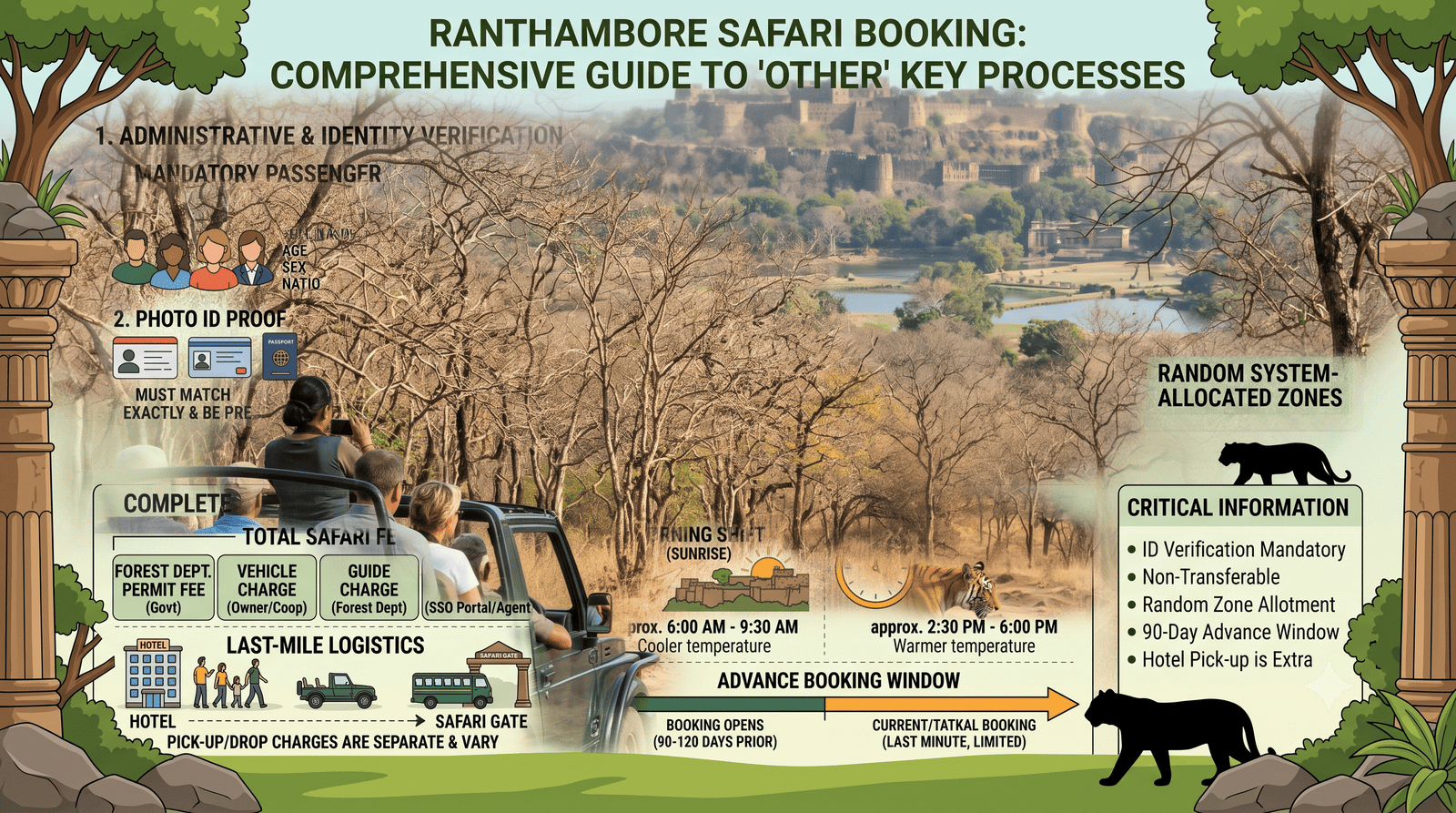
A Ranthambore safari booking is not simply buying a “ticket.” It is a forest department permit tied to a specific date, time slot (morning or evening), safari zone, and vehicle (Jeep/Gypsy or Canter), bundled with the vehicle rental, driver, and guide fee into one price. That bundling is exactly why prices you see quoted online can look so different — one site may be quoting the base government permit, another the price including an agent’s service fee, and a third a private/exclusive vehicle rate rather than a shared seat.
Safaris run inside Ranthambore Tiger Reserve, a roughly 1,300 sq. km reserve in Sawai Madhopur, Rajasthan, split into 10 numbered safari zones. Every vehicle is allocated to exactly one zone per safari — you don’t roam freely between zones on a single ride.
Official vs. Third-Party Booking — Know the Difference Before You Pay
This is the single most important thing most guides skip. There are, broadly, three ways to book:
- Directly through the Rajasthan Forest Department’s official system — the citizen-facing booking dashboard is reached through the Forest Department’s Aaranyak/FMDSS citizen services portal (accessible via forest.rajasthan.gov.in, under Forest & Wildlife → Wildlife Tourism Permission). This is the only channel where you pay the actual government permit price with no agent markup.
- Through your hotel or a registered local operator/naturalist, who books on your behalf through the same government system but adds a service fee for handling logistics, choosing zones strategically, and guiding you. This costs more but is legitimate and often worth it for first-time visitors.
- Through independent “booking” websites and WhatsApp agents that are not the government portal and not your hotel — some are legitimate resellers, others are unreliable. Several domains are styled to look official (“Ranthambore official safari booking”) without being run by the Forest Department.
None of these is inherently wrong, but you should always know which one you’re using, because it changes what price you should expect to pay and who to contact if something goes wrong.
How to verify you’re on a genuine government channel
- The URL should be a
.gov.ingovernment domain (or the officially linked Aaranyak/FMDSS booking system), not a.com/.incommercial-looking domain, however professional it looks. - Genuine government pricing will match the current gate-fee/permit structure — if a price looks dramatically higher than the government permit slab for the same vehicle and nationality, you’re paying an agent margin, which is fine as long as it’s disclosed.
- Be cautious of sites that pressure same-day payment over WhatsApp without a verifiable booking reference number tied to the forest department system.
- If in doubt, book through your hotel/resort — most Ranthambore properties handle safari booking daily and know the current legitimate rates.
How to Book a Ranthambore Safari Online — Step by Step
What you’ll need before you start
- Travel dates (remember: no safaris during the July–September monsoon closure)
- A preference for Jeep or Canter, and morning or evening
- Valid photo ID for every traveler — Aadhaar or another government photo ID for Indian nationals, passport details for foreign nationals
- A payment method (credit/debit card, net banking, or UPI are typically accepted)
The registration and booking steps
- Register on the booking portal with your email address and mobile number.
- Select your date, shift (morning/evening), and vehicle type (Jeep or Canter). Zone selection may be a specific zone or a grouped range depending on current availability rules — more on this below.
- Enter traveler details — full name, age, and ID type/number for every person in your group. Foreign travelers enter passport number and nationality.
- Review the price breakdown before paying — check nationality slab, vehicle type, and whether it’s a shared or private/exclusive booking.
- Complete payment securely through the portal’s payment gateway.
Payment and e-ticket
Once payment clears, you receive an e-ticket/confirmation, typically by email and SMS. Carry this — printed or on your phone — along with the original ID documents used at booking, since names and ID numbers are checked at the gate and mismatches can result in denied entry.
Jeep (Gypsy) Safari vs. Canter Safari
Jeep/Gypsy safari — what it’s like
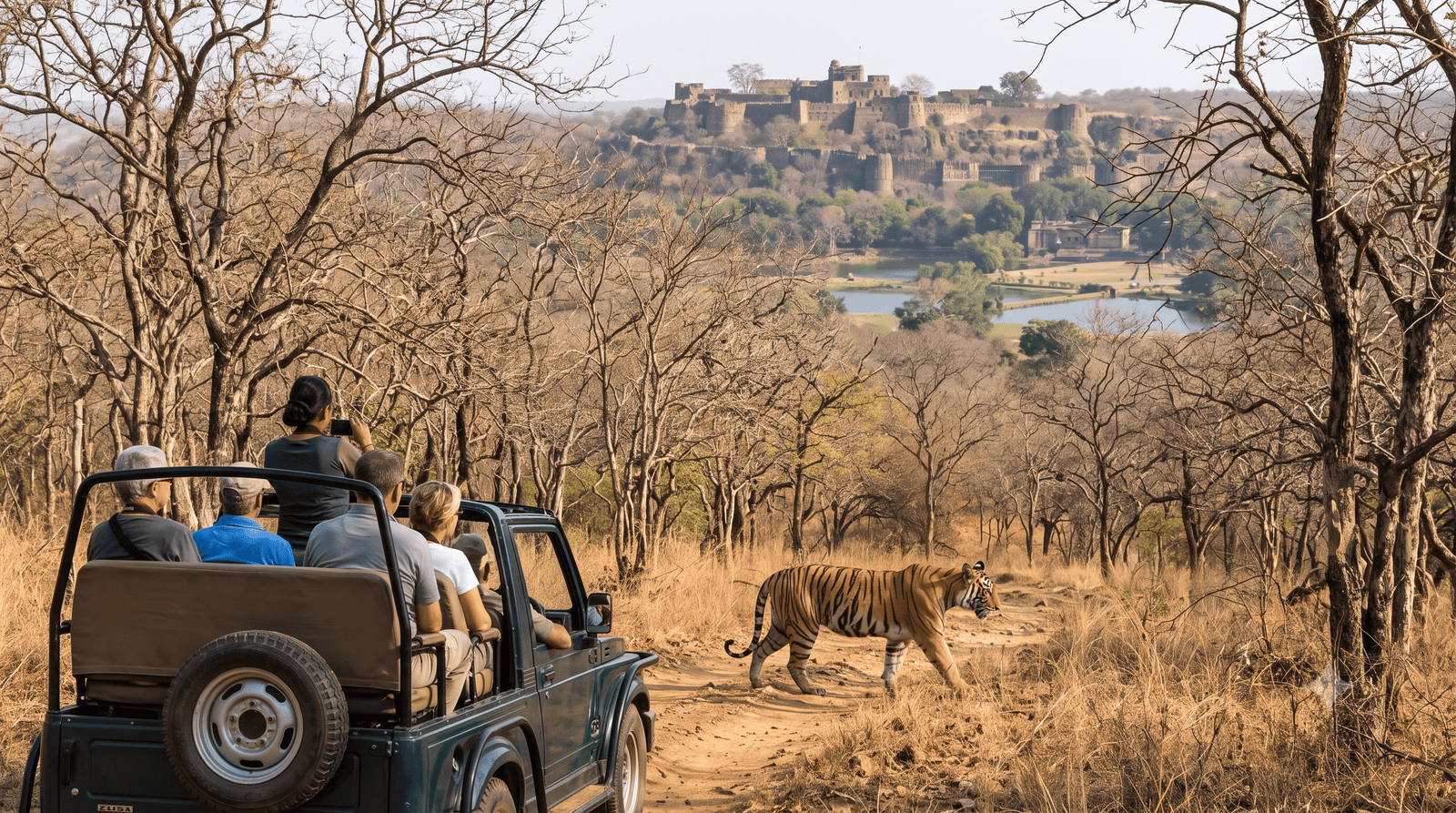
An open, six-seater 4×4 vehicle (including driver and guide, so around 5–6 paying seats). Jeeps can access all ten zones and give you a more personal, flexible, photography-friendly experience — everyone gets a window-adjacent view and the vehicle can maneuver more easily on narrow tracks.
Also Read: Ranthambhore Gypsy Safari Booking
Canter safari — what it’s like
An open-top, roughly 16–20-seater vehicle. It’s the budget-friendly option and works well for larger groups, families, or solo travelers happy to share the ride with strangers. The trade-off is a less personal experience and slightly less flexibility for photography angles.
Also Read : Canter safari Ranthambore
How to choose between them
- Choose Jeep if you’re a couple, small family, or serious photographer prioritizing sighting quality over cost, or if you want a private/exclusive vehicle.
- Choose Canter if you’re traveling in a larger group, on a tighter budget, or booking on short notice when Canter seats are more often available than full Jeeps.
- Either way, book as early as your dates allow — availability, not price, is usually the real constraint in peak season (November–February, and April–May).
Ranthambore Safari Prices — And Why They Vary So Much
Published prices across the web for the same nationality and vehicle type can differ by ₹1000–₹2,000 per person, and this confuses almost every first-time visitor. Here’s why:
What the price actually includes
A standard safari price bundles: the forest entry/permit fee, vehicle rental, driver fee, and guide fee. Personal photography with a standard camera or smartphone is normally included; commercial/professional filming usually requires a separate permit and fee.
Indian vs. foreign tourist pricing
Like most Indian tiger reserves, Ranthambore uses a two-tier pricing structure: Indian nationals pay a lower permit fee than foreign nationals for the same vehicle and zone. As a general 2026 reference range (always confirm live pricing):
| Vehicle | Indian nationals (per person, shared) | Foreign nationals (per person, shared) |
|---|---|---|
| Canter (shared) | roughly ₹1,500–₹2500 | roughly ₹3,500–₹5500 |
| Jeep/Gypsy (shared) | roughly ₹2,200–₹3500 | roughly ₹4,200–₹7,500 |
These ranges reflect the spread seen across current sources and the roughly 10% fee revision that took effect on 1 April 2026 — treat the low end as older/base pricing and the high end as the post-revision figure, and confirm the exact current number on the official portal at the time you book.
Private/exclusive vs. shared booking
Booking an entire Jeep or Canter privately (rather than sharing seats with strangers) costs significantly more, since you’re paying for all six (Jeep) or twenty (Canter) seats regardless of your group size. This is worth it for privacy, flexibility, and photography, and common for honeymooners or professional photographers.
Tatkal (last-minute) safari pricing
Ranthambore, like other reserves, offers a Tatkal (emergency/last-minute) booking window for visitors who couldn’t secure an advance slot. Tatkal permits are priced at a significant premium over standard advance booking — often several times the regular per-seat rate, since it’s typically sold as a full-vehicle premium rather than a shared per-seat price. Use Tatkal only as a backup, not a primary strategy, both because of cost and because availability is never guaranteed.
Advance Booking and Tatkal Booking Windows
Standard advance booking typically opens up to around 90 days before your travel date, on a first-come, first-served basis. In peak months (November–February and April–May), popular dates and zones can sell out weeks in advance. Tatkal booking exists specifically to cover short-notice travelers, released closer to the date, but at materially higher cost and no guarantee of your preferred zone or vehicle.
Practical takeaway: if you have fixed travel dates, book the moment the 90-day window opens for those dates. If you’re planning last-minute, budget extra for Tatkal or work through your hotel, which often has better last-minute access than the public portal.
Safari Zones and How Zone Allocation Works
Core zones (1–5) vs. buffer zones (6–10)
Ranthambore’s ten zones split broadly into core zones (1–5), generally associated with higher tiger density and more consistent sightings because they include key water bodies like Padam Talao, Raj Bagh Lake, and Malik Talao, and buffer zones (6–10), which are quieter, less crowded, and still offer genuine wildlife (including tigers, leopards, and sloth bears) with a different, often more scenic and less trafficked, experience.
Each core zone has its own character — for example, areas known for particular resident tigers, dense forest versus open grassland, or reliable waterhole activity — which is why serious repeat visitors research zones almost as carefully as dates.
How zones get assigned when you book
This is the part almost no competing page explains clearly. Zone allocation on the booking portal is not always “pick any single zone you want” — depending on current forest department rules, you may be asked to choose a specific zone number, or a grouped range (for example, a choice between zones 1–7 as one group and zones 8–10 as another), with the exact zone within that group assigned closer to your safari date or on the day itself. This means:
- Booking earlier improves your odds of a specific, high-demand zone.
- If you book through a resort or naturalist, they often have insight into which zones are running “hot” for sightings that week and can help you choose the group most likely to deliver what you want.
- Don’t assume a booking guarantees Zone 3 just because you requested it — always check the confirmation for what was actually allocated.
Safari Timings by Season
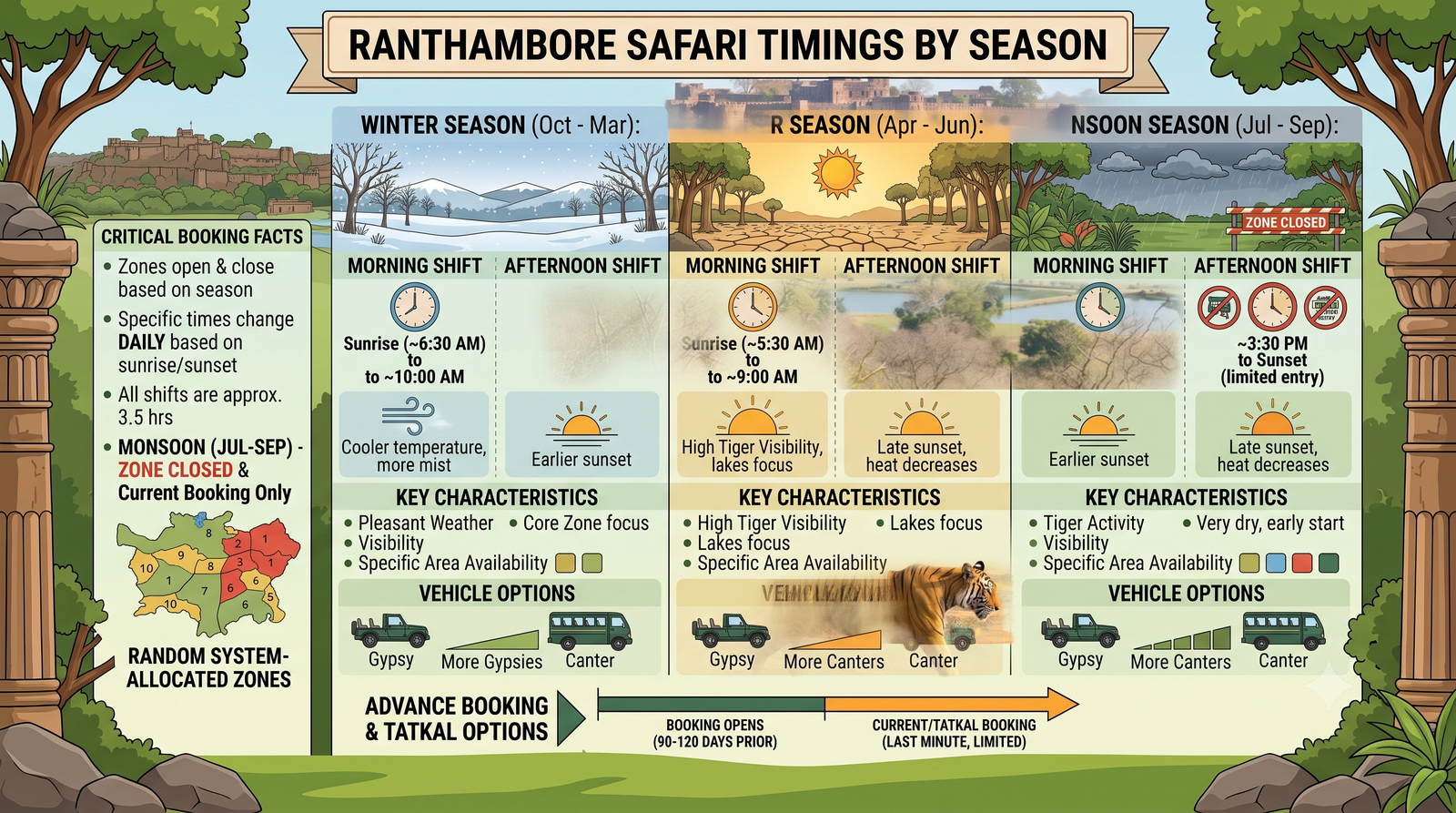
Timings shift with sunrise/sunset across the year. Approximate 2026 seasonal slots:
| Period | Morning Safari | Evening Safari |
|---|---|---|
| 1–31 October | 6:30 AM – 10:00 AM | 2:30 PM – 6:00 PM |
| 1 November – 31 January | 7:00 AM – 10:30 AM | 2:00 PM – 5:30 PM |
| 1 February – 31 March | 6:30 AM – 10:00 AM | 2:30 PM – 6:00 PM |
| 1 April – ~15 May | 6:00 AM – 9:30 AM | 3:00 PM – 6:30 PM |
| ~16 May – 30 June | 6:00 AM – 9:30 AM | 3:30 PM – 7:00 PM |
| July – September | Park closed (monsoon) | Park closed (monsoon) |
Each safari runs roughly 3.5 hours. The park is also closed one weekday (commonly Wednesday for core zones), so avoid booking that day for your planned zone.
Morning Safari vs. Evening Safari
Neither slot is definitively “better” — it depends on season and priorities:
- Morning safaris tend to be cooler and are often preferred in summer for comfort, and animals are frequently more active shortly after sunrise.
- Evening safaris can offer beautiful golden-hour light for photography and, in winter, a more comfortable temperature than the cold early morning.
- If your schedule and budget allow, booking both a morning and evening safari on different days (or even the same day) meaningfully improves your overall chance of a tiger sighting, since sightings vary day to day regardless of zone.
Required Documents and ID Rules
Indian nationals
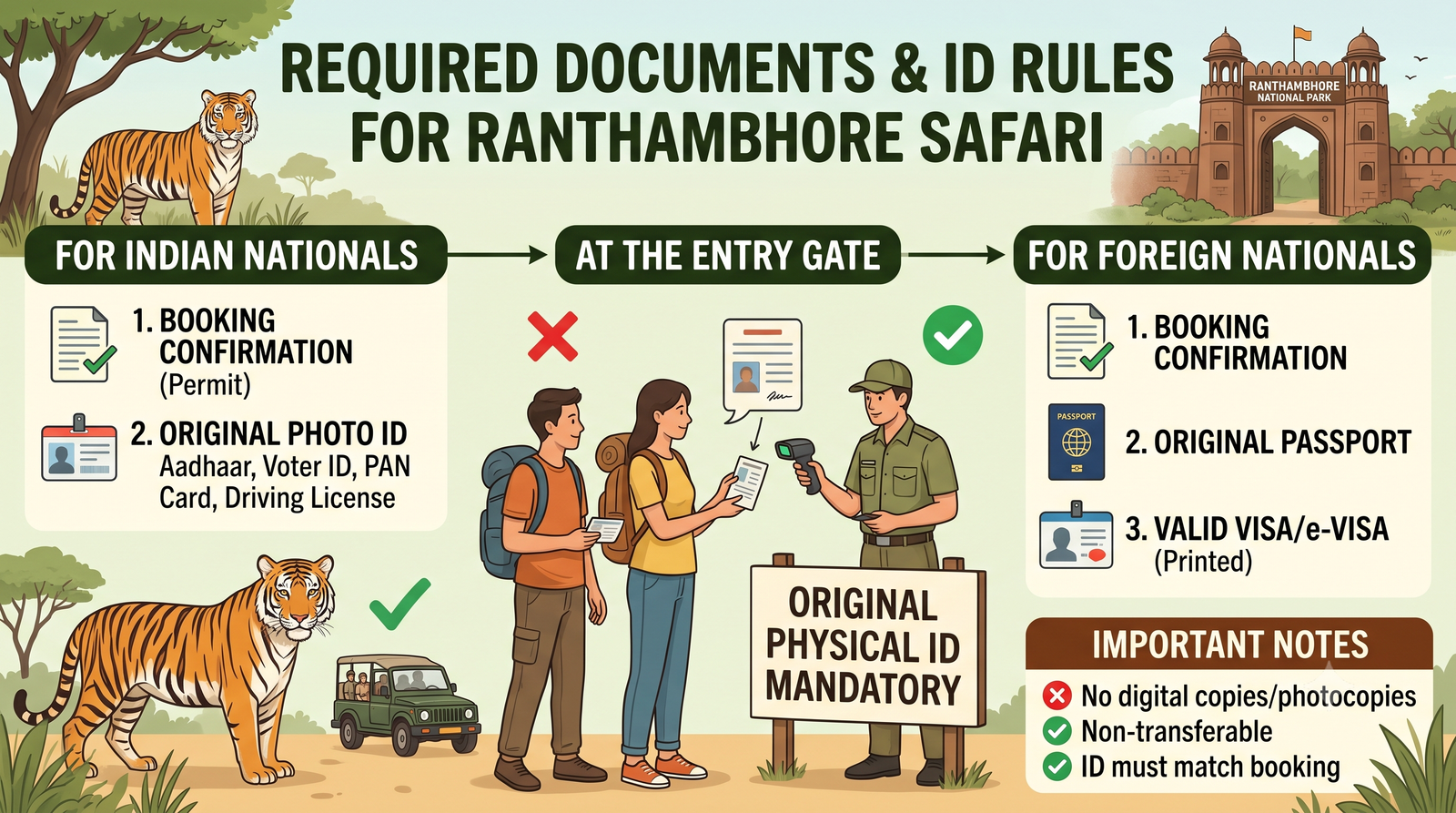
A valid government-issued photo ID — Aadhaar card, PAN card, driving licence, voter ID, or passport — is required for each traveler, entered exactly as it appears on the ID at the time of booking.
Foreign nationals
Foreign travelers must provide passport details (number and nationality) at the time of booking and carry the original passport on safari day. Foreign-national pricing applies regardless of how long you’ve lived in India, based on passport nationality, not residency.
Universal rule: the name and ID entered at booking must match the ID carried on the day. Mismatches are one of the most common reasons for denied entry — double-check spelling and ID numbers before you pay.
Children and Age-Related Rules
- Young children (commonly under 5 years) are typically allowed free or at a nominal charge, but rules can vary by portal update — confirm at the time of booking.
- Children above the free-age threshold generally require a full-price ticket, same as adults.
- There’s no strict upper-age restriction, but a 3.5-hour open-vehicle ride over uneven terrain is worth considering for very young children or anyone with mobility/health sensitivities — a private Jeep gives more flexibility to manage this than a shared Canter.
What’s Included and Excluded in Your Booking
Typically included: forest entry/permit fee, vehicle rental, driver, naturalist guide, and standard personal photography (phone/handheld camera).
Typically excluded: hotel pickup/drop (unless specifically arranged or included by an operator), meals, tips for the driver/guide (customary but discretionary, often ₹100–₹300 per person for a good safari), commercial photography/videography permits, and any government fee revision announced after your booking date — which, per standard forest department terms, is usually payable by the visitor at the gate if it applies.
Cancellation, Refund, and Rescheduling Rules
This is an area where most guides are vague, and it matters. General principles under current Rajasthan Forest Department practice:
- Once confirmed, safari bookings are generally non-refundable and non-transferable — this is stated clearly by most booking channels and reflects official policy, not just an agent’s terms.
- Exception: if a booking fails due to a technical error or a genuine unavailability of seats after payment, the amount is typically refunded to the original payment method — this is different from a visitor-initiated cancellation.
- Park closures (unscheduled, due to weather, VIP movement, or forest department discretion) are handled case by case; ask your booking channel’s specific policy for this scenario before you pay, since it isn’t uniformly guaranteed across all operators.
- Rescheduling a date is generally not supported the way it would be with a hotel booking — treat your date and zone selection as final once payment clears.
Practical advice: don’t book dates or zones speculatively hoping to change them later. Confirm your itinerary first, then book.
Best Time to Visit Ranthambore (and How It Affects Booking)
Winter (November–February)
The most comfortable weather (roughly 10–22°C daytime), lush post-monsoon scenery, and strong birdlife, but denser foliage can make tiger sightings slightly less certain than summer. This is peak demand season — book as early as your 90-day window allows.
Summer (March–June)
The best statistical window for tiger sightings, because shrinking water sources concentrate wildlife around a handful of lakes and waterholes, even though daytime temperatures can exceed 40°C. Zones with reliable water (like those around Padam Talao, Raj Bagh, and Malik Talao) perform especially well in this window. Demand is high for exactly this reason — early April through mid-May bookings fill quickly among serious wildlife photographers.
Monsoon closure (July–September)
The park’s core tourist zones are closed for the breeding season and to allow the terrain to recover; some buffer-zone or alternative experiences (like a boat safari on the Chambal) may remain available, but don’t plan a core-zone Ranthambore tiger safari in this window.
How Early Should You Book?
- For fixed travel dates: book the moment your dates fall within the advance-booking window (commonly up to ~90 days out), especially for November–February and April–May travel.
- For flexible dates: you have more room to shop for availability, but still book at least a few weeks ahead if possible — same-week availability is unreliable in peak season.
- For last-minute trips: expect to rely on Tatkal booking or your hotel’s local access, and budget for a materially higher price.
Common Ranthambore Safari Booking Mistakes to Avoid
- Assuming the first “official-looking” website is the government portal. Many aren’t — verify the domain.
- Entering ID details incorrectly (misspelled names, wrong document numbers), which can cause denied entry even with a valid, paid booking.
- Booking a shared Canter expecting a private experience, or vice versa paying for a private vehicle unnecessarily for a solo traveler on a budget.
- Not checking which zone group you’re actually booking (a specific zone vs. a range), then being surprised by the allocation.
- Treating “Tatkal” as a shortcut to a better price — it’s the opposite; it’s a premium, last-resort option.
- Booking only one safari when sighting probability meaningfully improves with two or more safaris across different zones/slots.
- Ignoring the monsoon closure and trying to plan a July–September core-zone safari.
- Assuming a booking can be rescheduled or refunded like a hotel — plan your dates carefully before paying.
Tips for First-Time Visitors
-
Dress in muted, neutral colors and layer for early-morning cold even in warmer months.
-
Carry water, sunscreen, and, in winter, warm layers — open vehicles get genuinely cold before sunrise.
-
Keep phones/cameras charged; battery drains faster in cold, and you don’t want to miss a sighting.
-
Stay quiet and still during sightings — noise and sudden movement reduce everyone’s viewing time.
-
If sighting a tiger is your top priority, favor summer (March–June) over the more comfortable but less sighting-dense winter months.
-
Book two safaris if your schedule and budget allow — it’s the single biggest lever you control for improving your odds.
Frequently Asked Questions
1. What is the official website to book a Ranthambore safari?
Bookings are ultimately processed through the Rajasthan Forest Department’s citizen services system (accessible via forest.rajasthan.gov.in and its linked Aaranyak/FMDSS booking dashboard). Many private and hotel-run booking sites also route through this same government system on your behalf for a service fee — always confirm which type of channel you’re using.
2. How far in advance can I book a Ranthambore safari?
Advance booking generally opens up to around 90 days before your travel date. Popular winter and summer dates can sell out weeks ahead, so book as soon as your dates fall within that window.
3. What is the difference between Jeep and Canter safari in Ranthambore?
A Jeep (Gypsy) is a smaller, six-seat open 4×4 offering a more personal, flexible experience, while a Canter is a larger, roughly 16–20-seat open vehicle that’s more budget-friendly for bigger groups but less private.
4. How much does a Ranthambore safari cost?
As a general 2026 reference, shared Canter seats run roughly ₹1,500–₹1,800 for Indian nationals and ₹3,500–₹4,200 for foreign nationals; shared Jeep seats run roughly ₹2,200–₹2,500 for Indian nationals and ₹4,200–₹5,000 for foreign nationals. Private/exclusive vehicles and Tatkal bookings cost significantly more. Always confirm the live price at booking.
5. Can I get a refund if I cancel my Ranthambore safari booking?
Generally no — confirmed bookings are treated as non-refundable and non-transferable under standard forest department terms. Refunds are typically issued only when a booking fails due to a technical error or unavailability on the department’s end, not for visitor-initiated cancellations.
6. What documents do I need to book a Ranthambore safari?
Indian nationals need a valid government photo ID (Aadhaar, PAN, driving licence, voter ID, or passport). Foreign nationals need their passport details at booking and must carry the original passport on the safari day.
7. Which is the best zone for tiger sighting in Ranthambore?
Core zones 1–5 generally offer higher tiger density, particularly zones with reliable water sources like those around Padam Talao, Raj Bagh Lake, and Malik Talao. That said, zone allocation is often grouped rather than individually guaranteed, and sightings vary week to week, so no single zone is a certainty.
8. Is morning or evening safari better in Ranthambore?
Both offer strong sighting chances; mornings tend to be cooler and often more active, evenings offer better light for photography and, in winter, warmer temperatures. Booking both, on different slots or days, improves your overall odds more than choosing one over the other.
9. What is Tatkal booking in Ranthambore?
Tatkal is a last-minute booking option for travelers who missed the standard 90-day advance window. It’s released closer to the travel date at a significant price premium over standard booking and isn’t guaranteed for any specific zone.
10. Are children allowed on a Ranthambore safari, and is there an age limit?
Yes, children are allowed; very young children (commonly under 5) are often free or discounted, while older children typically pay the full fare. There’s no strict upper age limit, but consider comfort for very young children on a 3.5-hour open-vehicle ride.
11. When is Ranthambore National Park closed?
The park is closed for the monsoon season, typically July through September, and closed weekly on a fixed day (commonly Wednesday for core zones), which varies slightly by zone group.
12. Can I book a Ranthambore safari through my hotel instead of online?
Yes — most hotels and resorts near Ranthambore can book safaris on your behalf through the same government system, usually for a service fee. This is a reliable option, especially for last-minute or zone-strategy help.