Once a royal hunting ground — you can read the full backstory in The History of Ranthambhore — Ranthambhore is today one of India’s greatest tiger conservation success stories, and there’s no better time to revisit that story than around Tiger Day.
Quick Answer
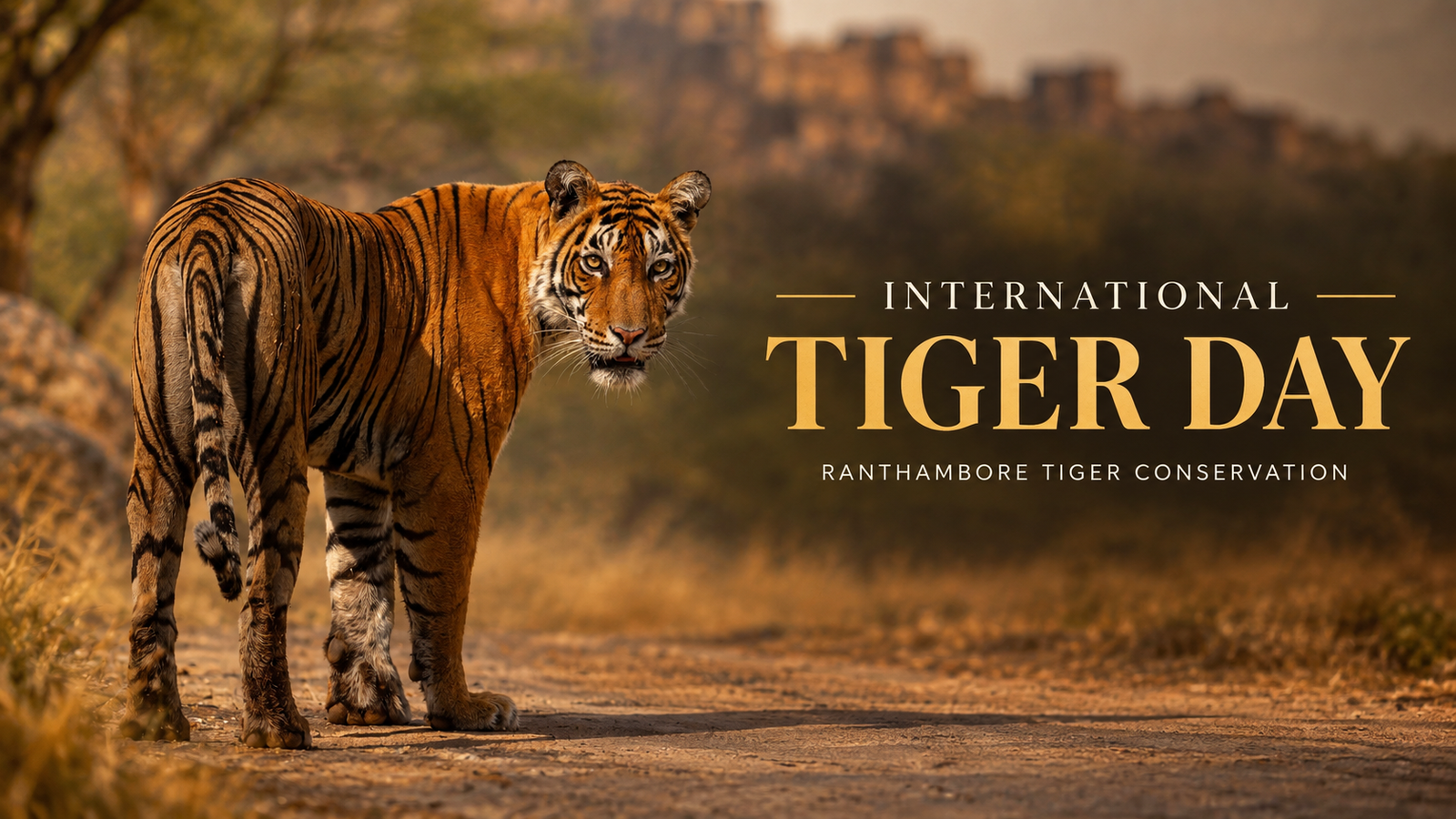
International Tiger Day (also called Global Tiger Day or World Tiger Day) is observed every year on July 29 to raise awareness about wild tiger conservation. It marks the 2010 St. Petersburg Tiger Summit, where 13 tiger-range countries pledged to double the world’s wild tiger population by 2022. India, home to over 70% of the world’s wild tigers, plays the leading role in this recovery — and Ranthambhore National Park, one of the country’s first nine tiger reserves, is one of its clearest success stories.
Key Facts at a Glance
| Fact | Detail |
|---|---|
| Date observed | July 29, every year |
| Established | 2010, St. Petersburg Tiger Summit, Russia |
| Also known as | Global Tiger Day, World Tiger Day |
| Goal set in 2010 | “Tx2” — double wild tiger numbers by 2022 |
| Wild tigers in 2010 | ~3,200 globally |
| Wild tigers today | Under 5,000 globally, ~3,600+ in India |
| India’s share of world’s wild tigers | Over 70% |
| Tiger-range countries | 13, including India, Nepal, Bhutan, Bangladesh, Russia, Indonesia |
| India’s conservation program | Project Tiger, launched 1973 |
| Regulatory body | National Tiger Conservation Authority (NTCA), formed 2005 |
| Ranthambhore’s status | One of India’s first 9 tiger reserves under Project Tiger |
| Ranthambhore tigers in 2005 | ~25 |
| Ranthambhore tigers today | Estimated 70–80+ |
Key Definitions
- International Tiger Day — an annual global awareness day (July 29) dedicated to wild tiger conservation and habitat protection.
- Project Tiger — India’s flagship tiger conservation program, launched in 1973, that established a network of protected tiger reserves across the country.
- NTCA (National Tiger Conservation Authority) — the Indian government body formed in 2005 to oversee tiger reserve management, anti-poaching policy, and population monitoring.
- Tx2 Goal — the pledge made at the 2010 St. Petersburg Summit to double the global wild tiger population by 2022.
- Tiger-range countries — the 13 nations where wild tigers still exist in the wild: India, Bangladesh, Bhutan, Cambodia, China, Indonesia, Laos, Malaysia, Myanmar, Nepal, Russia, Thailand, and Vietnam.
Important Entities
- IUCN (International Union for Conservation of Nature) — lists the tiger as endangered and leads global coexistence initiatives tied to Tiger Day.
- WWF (World Wildlife Fund) — a key partner in tiger corridor protection and community-based monitoring around reserves like Ranthambhore.
- Government of India / NTCA — administers Project Tiger and India’s 58 tiger reserves.
- Ranthambhore National Park — a flagship reserve in Sawai Madhopur, Rajasthan, and one of the first nine reserves under Project Tiger.
- Machli — Ranthambhore’s most famous tigress, whose visibility around the park’s lakes made her a global wildlife icon.
When and Why Is International Tiger Day Celebrated
International Tiger Day traces back to the 2010 St. Petersburg Tiger Summit in Russia, where leaders from the 13 tiger-range countries met to confront a genuinely alarming crisis: wild tiger numbers had crashed to roughly 3,200, down from over 100,000 a century earlier — a decline of nearly 97% in a hundred years. Out of that summit came the Tx2 goal — double the global wild tiger population by 2022 — and July 29 was set aside every year to track progress and renew the commitment.
Each year carries its own theme. IUCN’s framing for 2026, “Coexistence in action: Scaling solutions for people and tigers,” shifts the spotlight onto the Indigenous Peoples, local communities, and frontline conservation teams making it possible for people and tigers to share the same landscapes safely. (You may see slightly different theme wording on some sites — this reflects how different organisations frame the same year’s priorities.)
The day now serves a simple purpose: keep tigers, and the forests they depend on, in the public conversation. Protecting a tiger population means protecting entire ecosystems — rivers, prey species, and the biodiversity that comes with a healthy forest.
Ranthambhore’s Role in India’s Tiger Revival
India is home to over 70% of the world’s wild tiger population, and Ranthambhore has been central to that recovery since long before Tiger Day existed. When Project Tiger launched in 1973, Ranthambhore was named one of the very first nine tiger reserves in the country — a turning point that transformed a former royal hunting estate into one of India’s most protected wild spaces.
The numbers tell the story of that transformation. In 2005, poaching and habitat pressure had pushed Ranthambhore’s tiger population down to around 25 individuals. Two decades of sustained conservation work later, recent estimates put the population at 70 to 80-plus tigers across the reserve and its buffer landscape — one of the most remarkable recoveries of any tiger habitat in the world.
The Tigers That Made Ranthambhore Famous
Part of what makes Ranthambhore special is that its tigers aren’t anonymous statistics — many are practically celebrities. The forest department assigns every tiger a unique ID (T1 through T130-plus and counting) once it separates from its mother, and naturalists track individuals by their one-of-a-kind stripe patterns, the same way no two fingerprints are alike.
The most legendary of them all was Machli, the tigress whose reign over Ranthambhore’s lakes made her one of the most photographed tigers on Earth and turned Ranthambhore into a global wildlife destination in its own right. Today, her descendants — along with dominant males and new litters of cubs spotted across zones 2, 3, and 4 — carry that legacy forward.
Ranthambhore’s Tiger Population Over Time
| Year | Estimated Tiger Count | Context |
|---|---|---|
| 2005 | ~25 | Population low point after poaching pressure |
| 2010 | ~30–35 | Early recovery under stricter Project Tiger enforcement |
| 2022 | ~69–88 | NTCA census plus post-census cub additions |
| 2026 | ~70–80+ | Sustained growth across core and buffer zones |
Why This Matters for Anyone Planning a Safari
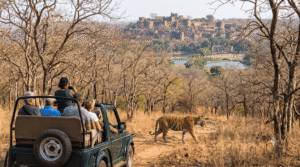
Tiger Day isn’t just a conservation headline — it’s a good reminder of what’s actually at stake every time you head into the park on a safari. A tiger sighting in Ranthambhore isn’t luck alone; it’s the outcome of five decades of forest protection, anti-poaching patrols, and careful zone management.
- October to June is when the park is open, split across ten distinct safari zones.
- April to June, despite the heat, remains prime tiger-sighting season, as the animals move toward waterholes more predictably.
- Zones 1 through 5 sit within Ranthambhore’s core tiger territory and typically offer the highest sighting probability.
Every responsible safari booking — choosing a government-authorised operator, staying within vehicle limits, keeping a respectful distance — plays a small part in keeping this conservation story on track. If you’re weighing your options, our Gypsy Safari, Canter Safari, and Full Day Safari pages break down which format suits your group size and budget best.
How You Can Mark International Tiger Day
You don’t need to be a wildlife scientist to take part. A few meaningful ways to observe the day:
- Visit responsibly. If you’re planning a trip to Rajasthan around this time, book a safari with an authorised operator and let the visit double as an act of support for the reserve.
- Learn the story. Understanding how Ranthambhore went from 25 tigers to 80 is a reminder that conservation works when it’s sustained.
- Spread awareness. Share what you know about Project Tiger, habitat corridors, and why apex predators matter — most people have never heard the full story.
- Support local communities. Villages on Ranthambhore’s periphery play a direct role in conservation; tourism that respects and includes them strengthens the whole system.
- Extend your stay. Pairing your safari with a night or two nearby gives you more shots at a sighting — see our recommended Hotels & Stays near the park.
Frequently Asked Questions (FAQs)
1. When is International Tiger Day celebrated?
Every year on July 29, marking the anniversary of the 2010 St. Petersburg Tiger Summit.
2. How many tigers are there in Ranthambhore today?
Recent estimates place the population between 70 and 80-plus tigers across the reserve and surrounding landscape, up from around 25 in 2005.
3. Why was Ranthambhore chosen as one of India’s first tiger reserves?
It was named one of the original nine reserves under Project Tiger in 1973, largely because its terrain and existing forest cover made it viable for long-term tiger protection.
4. Who was Machli, and why is she famous?
Machli was a tigress whose long reign over Ranthambhore’s lake zones and frequent, striking sightings made her one of the most photographed tigers in the world, helping put Ranthambhore on the global wildlife map.
5. What is the best time to visit Ranthambhore for tiger sightings?
The park is open October through June, with April to June generally offering the strongest sighting odds as tigers move toward water sources more predictably.
6. What percentage of the world’s wild tigers live in India?
More than 70% of all wild tigers alive today live in India, largely due to Project Tiger and NTCA-led conservation efforts.
Conclusion
International Tiger Day is a reminder of how far tiger conservation has come — and Ranthambhore is living proof that recovery is possible when protection is taken seriously. Whether you’re planning your first safari or your fifth, every visit into these ten zones connects you to a fifty-year story of survival, resilience, and the return of India’s most iconic predator. To learn more about the park before you go, browse our About Ranthambhore page and our Photo Gallery for a preview of what awaits.
Ready to see it for yourself? Book your Ranthambhore safari and be part of the story. Have questions first? Reach out via our Contact page.
Sources & Further Reading
- IUCN — Global Tiger Day 2026 coverage
- WWF India — Ranthambhore Tiger Reserve conservation updates
- National Tiger Conservation Authority (NTCA) / Project Tiger, Government of India
- Wikipedia — International Tiger Day (background and past themes)