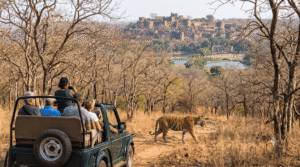
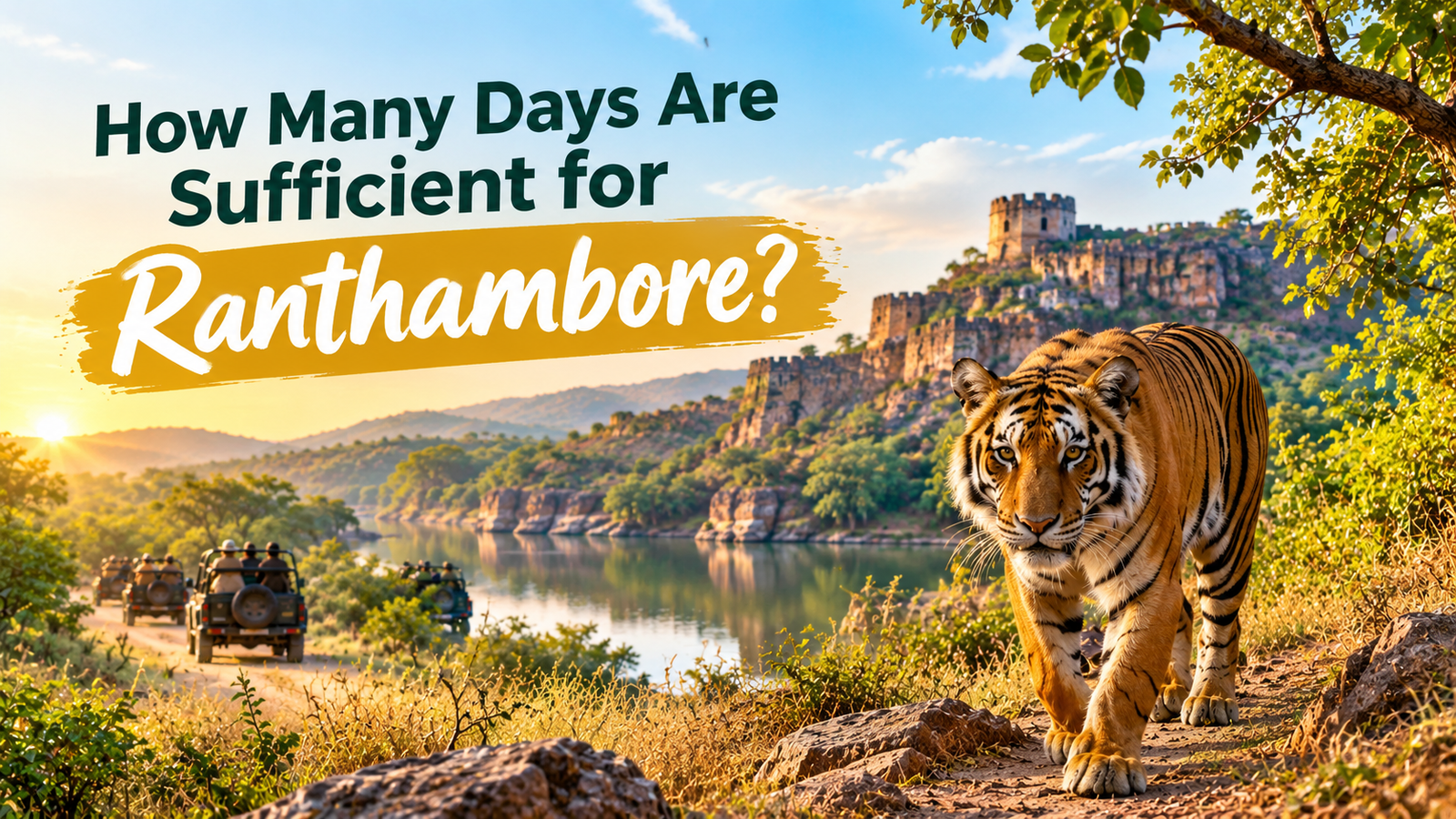
Ranthambore is one of the few places in India where a wild tiger can walk past a ruined palace or a lakeside pavilion in full daylight. It is also a place where plenty of visitors leave without seeing a single stripe, and the reason is rarely a shortage of tigers. It is a shortage of time. A traveller books one safari, draws a quiet zone or an unlucky morning, and flies home disappointed.
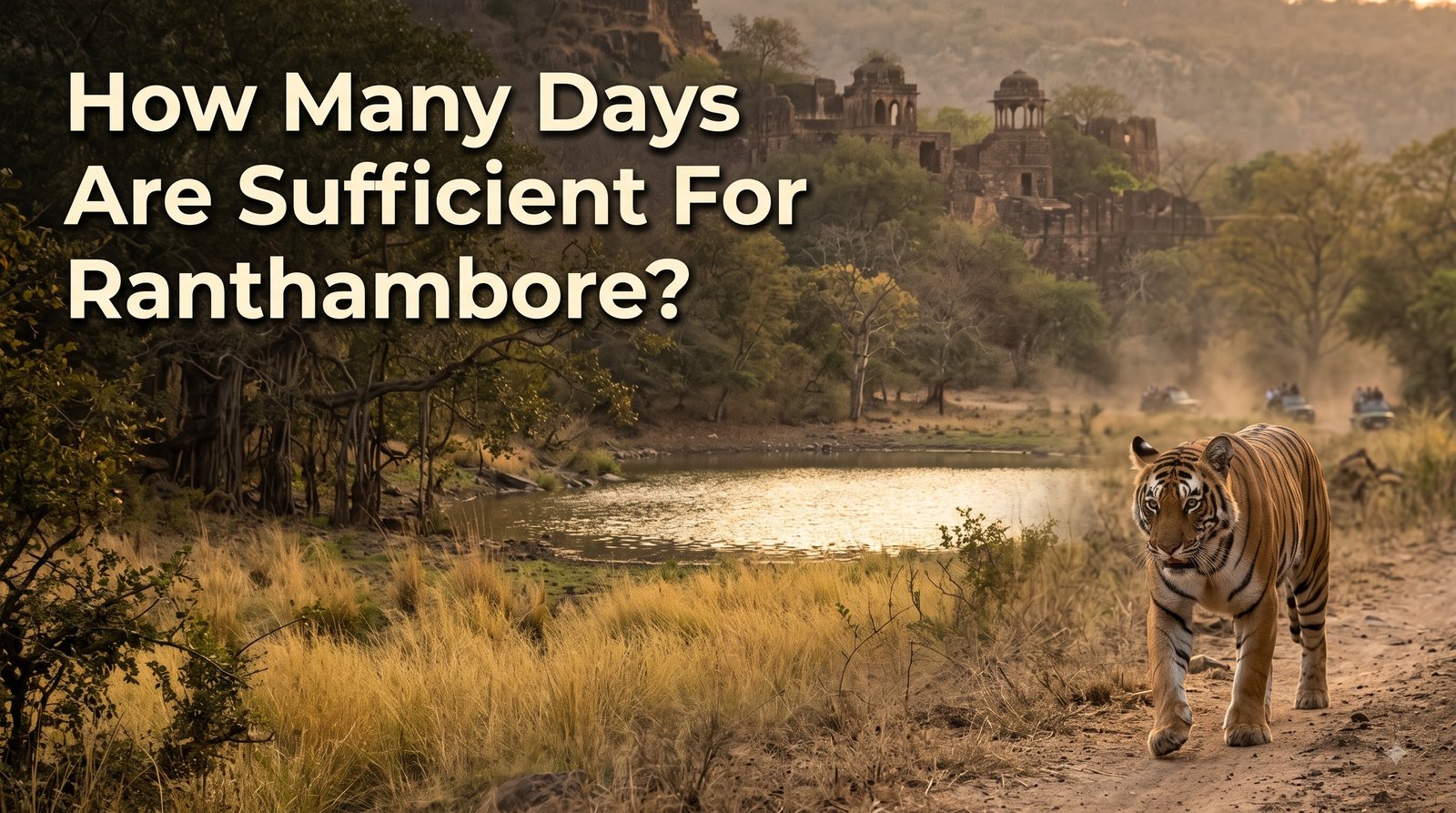
This guide answers the planning question properly: how many days are sufficient for Ranthambore, what to do with each day, and how to turn a few safaris into the best possible odds. It also covers timings, zones, costs, routes, stays, rules and the mistakes that cost travellers the most.
The short answer: For most visitors, two nights and three days (three to four safaris) is sufficient for Ranthambore. One day is enough for a taster, and four days suits photographers, families and anyone who wants the fort and a relaxed pace as well.
How Many Days Are Sufficient for Ranthambore?
The right length depends on how much you want a tiger sighting, how much you want the rest of the region, and your budget. Each safari is a separate permit, so days and safaris move together.
| Trip length | Safaris | Best for | Tiger-sighting outlook* |
|---|---|---|---|
| 1 day (day trip) | 1–2 | Tight schedules, a quick taster | Possible, but largely down to luck |
| 2 days / 1 night | 2–3 | Weekend trips, first-timers | Fair |
| 3 days / 2 nights (recommended) | 3–4 | Most travellers, best value | Good |
| 4 days / 3 nights | 4–6 | Photographers, families, safari plus fort | Very good |
| 5+ days | 6+ | Dedicated wildlife photographers | Highest |
*This is a qualitative judgement, not an official statistic. Nobody can guarantee a tiger sighting, because the animals are wild and free-ranging.
Why one safari is rarely enough
A standard safari lasts about three and a half hours inside one zone. Tigers move across territories, rest through the heat of the day, and are hidden by vegetation for part of the year. Weather, vehicle traffic and the zone you are allotted all change what you see. Multiple safaris in different zones and different shifts spread that risk.
Why more than four days is usually unnecessary
Beyond the fourth or fifth safari, each extra permit adds cost faster than it adds probability. The exception is a serious photographer who wants specific light, behaviour or a particular tigress and her cubs. For everyone else, three to four well-planned safaris plus the fort is a complete trip.
Ranthambore Itineraries: 1, 2, 3 and 4 Days
All plans assume the park is open (October to June) and that you have secured permits in advance. Always confirm current safari timings before fixing flights or trains.

1-Day Ranthambore Itinerary (Day Trip)
Best for travellers short on time. Realistically you will manage one or two safaris.
Option A: overnight train arrival (two safaris)
- Early morning: Arrive at Sawai Madhopur by an overnight or early train, freshen up and collect your boarding pass.
- Morning safari: Enter the park for the first shift.
- Midday: Brunch, then visit Ranthambore Fort and the Ganesh Temple (see the attractions section below).
- Afternoon safari: Second drive, ideally in a different zone.
- Evening: Catch a return train or stay one more night if you can.
Option B: road trip from Jaipur (one safari)
Leave Jaipur mid-morning, reach by early afternoon, collect your boarding pass and take the afternoon safari. The return drive is long after dark, so this works only if you accept one safari. See our Ranthambore to Jaipur distance and travel guide for road, rail and air options.
2-Day Ranthambore Itinerary (1 Night)
A comfortable weekend plan with two to three safaris.
- Day 1: Arrive by late morning, check in and rest. Collect the boarding pass, take the afternoon safari, and enjoy dinner at your resort.
- Day 2: Morning safari, brunch, then Ranthambore Fort and the temple. Add an optional afternoon safari if your schedule allows, then depart in the evening.
3-Day Ranthambore Itinerary (2 Nights): Recommended
This is the sweet spot. It gives you four safaris across different shifts and zones without feeling rushed.
- Day 1: Arrive, check in, afternoon safari. Early night, since mornings start early.
- Day 2: Morning safari. Brunch and rest. Late-morning visit to Ranthambore Fort or Surwal Lake. Afternoon safari in a different zone.
- Day 3: Final morning safari. Check out and depart by afternoon.
Why it works: Four safaris across three days gives you two mornings and two afternoons, a mix of zones, and a built-in buffer if one shift is lost to rain or a traffic jam around a sighting.
4-Day Ranthambore Itinerary (3 Nights)
Ideal for photographers, families and anyone who wants Ranthambore at an unhurried pace.
- Day 1: Arrival and an easy afternoon safari.
- Day 2: Morning and afternoon safaris, with a slow midday at your resort.
- Day 3: Offbeat day: Ranthambore Fort at opening time, the Ganesh Temple, Surwal Lake birdwatching, a craft stop, or Khandar Fort for the adventurous. Add an afternoon safari.
- Day 4: One last morning safari, then depart.
If you prefer maximum time inside the reserve in a single day, read about the full-day safari option.
Best Time to Visit Ranthambore
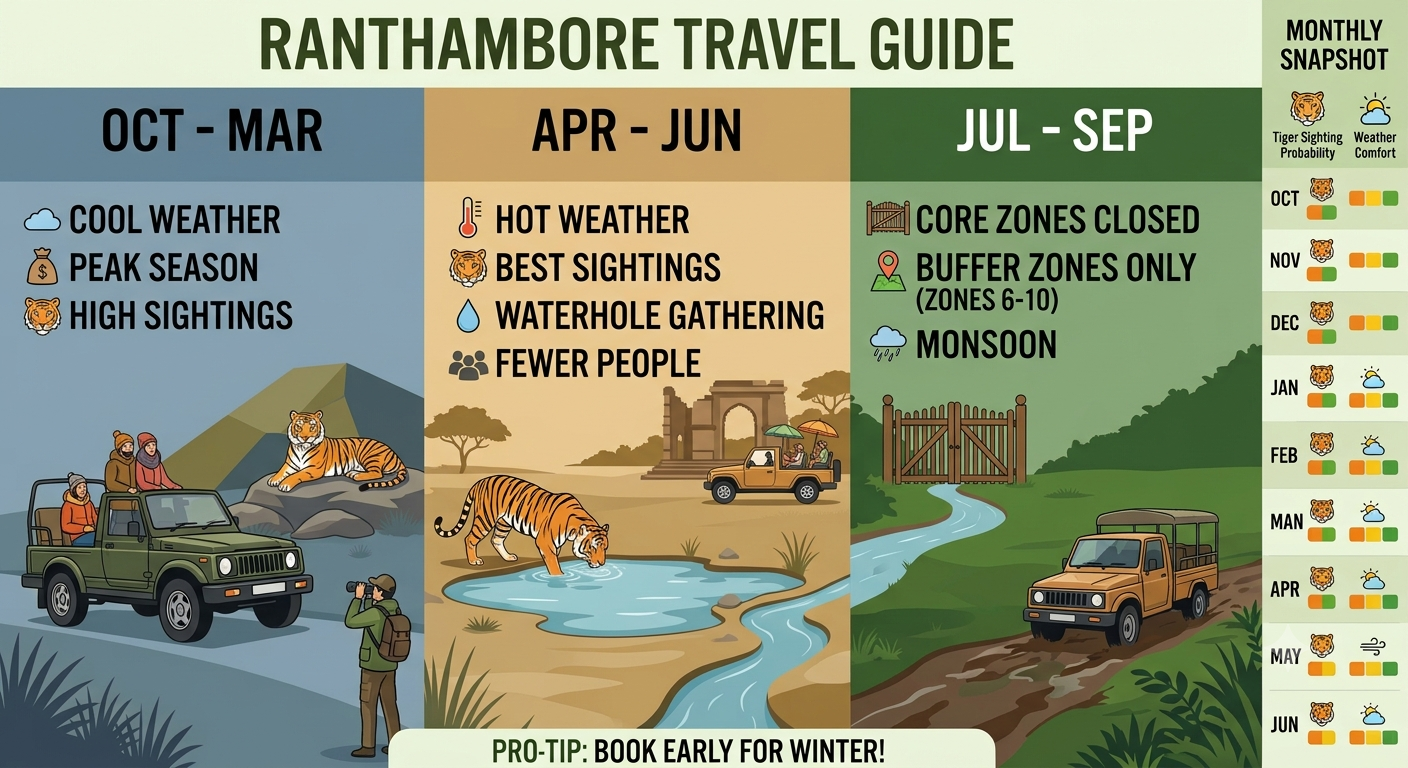
The park is open October 1 to June 30. The core zones close from July 1 to September 30 for the monsoon and breeding season, though some buffer zones may run limited safaris depending on weather.
| Months | Weather | What to expect |
|---|---|---|
| October | Warm, humid, lush after monsoon | Park reopens, great scenery, thick vegetation can hide animals, high early demand |
| November–February | Pleasant days, cold mornings (open jeeps feel chilly) | Peak tourist season, comfortable for families, good birdwatching |
| March | Warming up, forest drying out | Good balance of comfort and visibility |
| April–June | Very hot, often above 40°C | Sparse foliage, animals gather at waterholes, many experienced guides rate this the best sighting window |
| July–September | Monsoon | Core zones closed |
Which is best? For comfort, choose November to March. For the highest sighting odds and photographers who can handle heat, choose April to June. Either way, book early, because both windows are busy.
Safari Timings, Duration and Vehicle Types
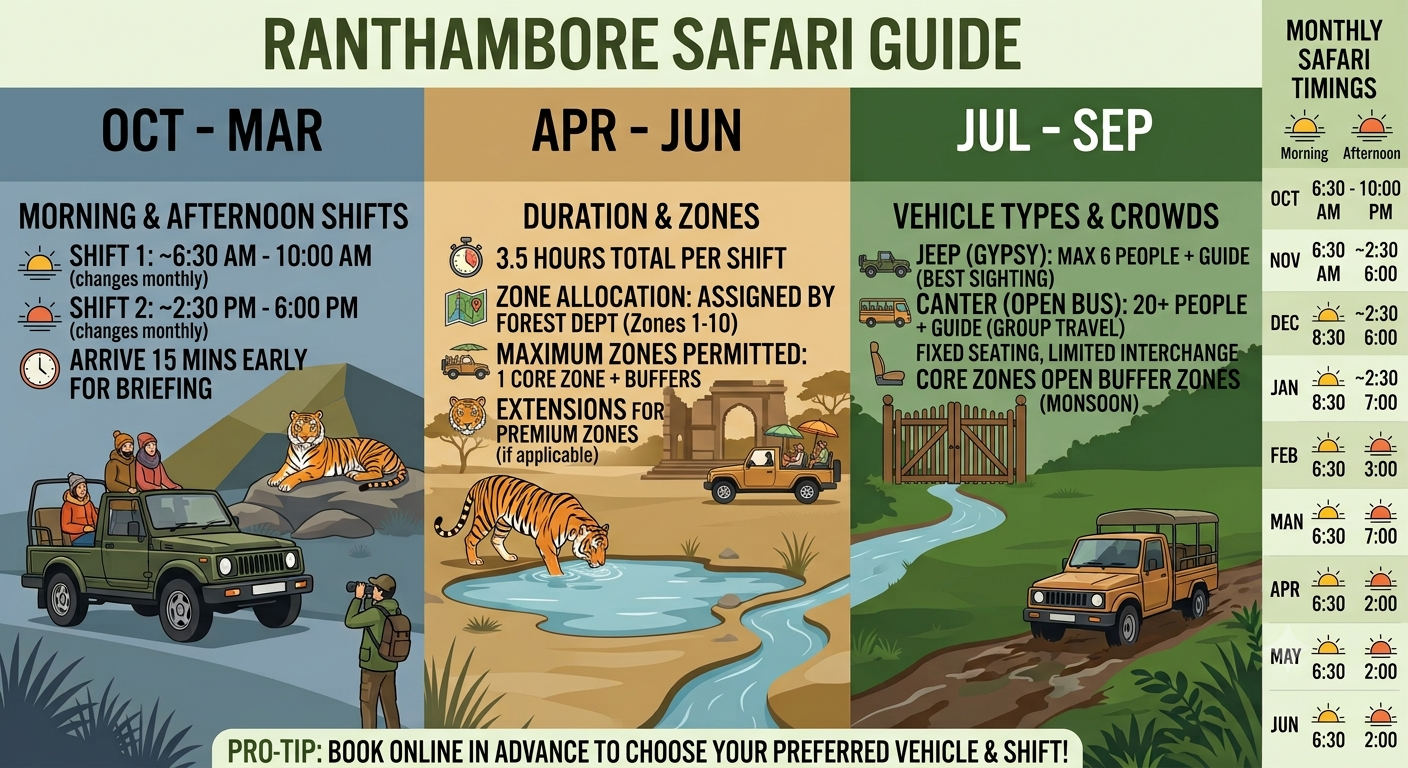
Safaris run twice a day in two shifts, each about 3 to 3.5 hours. Timings change through the year with sunrise and sunset, and the forest department can revise them, so confirm before you travel.
| Period | Morning safari | Afternoon safari |
|---|---|---|
| October 1–31 | 6:30–10:00 AM | 2:30–6:00 PM |
| November 1–January 31 | 7:00–10:30 AM | 2:00–5:30 PM |
| February 1–March 31 | 6:30–10:00 AM | 2:30–6:00 PM |
| April 1–May 15 | 6:00–9:30 AM | 3:00–6:30 PM |
| May 16–June 30 | 6:00–9:30 AM | 3:30–7:00 PM |
| July 1–September 30 | Core zones closed | Core zones closed |
Source: park timing schedule as published by travel resources at the time of writing; verify with the Rajasthan Forest Department.
Gypsy (jeep) vs canter
| Feature | Gypsy | Canter |
|---|---|---|
| Seats | 6 | 20 |
| Cost per seat | Higher | Lower |
| Manoeuvrability | Excellent, quieter, closer to sightings | Slower and noisier |
| Best for | Couples, small groups, photographers | Budget travellers, large families |
| Zone restrictions | None | Reportedly not permitted in Zones 7 and 8 |
A Gypsy gives a more intimate, flexible drive. A canter is cheaper and its higher seats can help you see over bushes. Read more on our Gypsy safari and Canter safari pages.
Half-day and full-day permits
Beyond the standard shifts, longer permits exist for those who want extended time in the park. They cost considerably more and are best only for photographers or very determined tiger seekers.
How to Book a Ranthambore Safari
- Check dates. Bookings open 90 days in advance. Peak-season core-zone slots can sell out within hours of opening.
- Use an official or trusted channel. Book through the Rajasthan Forest Department portal or through a registered operator or hotel. Look-alike sites run by agents are common, so check the site before paying.
- Prepare traveller details. Name, age and gender exactly as shown on each traveller’s government ID, plus the ID number.
- Choose the date and shift. Morning or afternoon.
- Pay in full. Confirmed bookings are generally non-refundable and non-transferable.
- Collect boarding passes. You collect passes from the reception centre in Sawai Madhopur shortly before your shift (commonly about an hour prior) with the same original ID used when booking.
If sold out: A last-minute (Tatkal) window opens shortly before each shift on a first-come basis, at a steep premium. Treat it as a backup, not a plan.
For a step-by-step walkthrough, see our complete Ranthambore safari booking guide.
Chances of Spotting Tigers and Other Wildlife
Ranthambore is among India’s best tiger reserves for sightings, in part because its tigers are used to vehicles and often active in daylight. Rajasthan forest officials reported around 72 tigers in the Ranthambore reserve in 2026, up from 66 the previous year, including cubs. That is well above the estimated carrying capacity of 40 to 50, which is one reason tigers occasionally disperse to neighbouring forests.
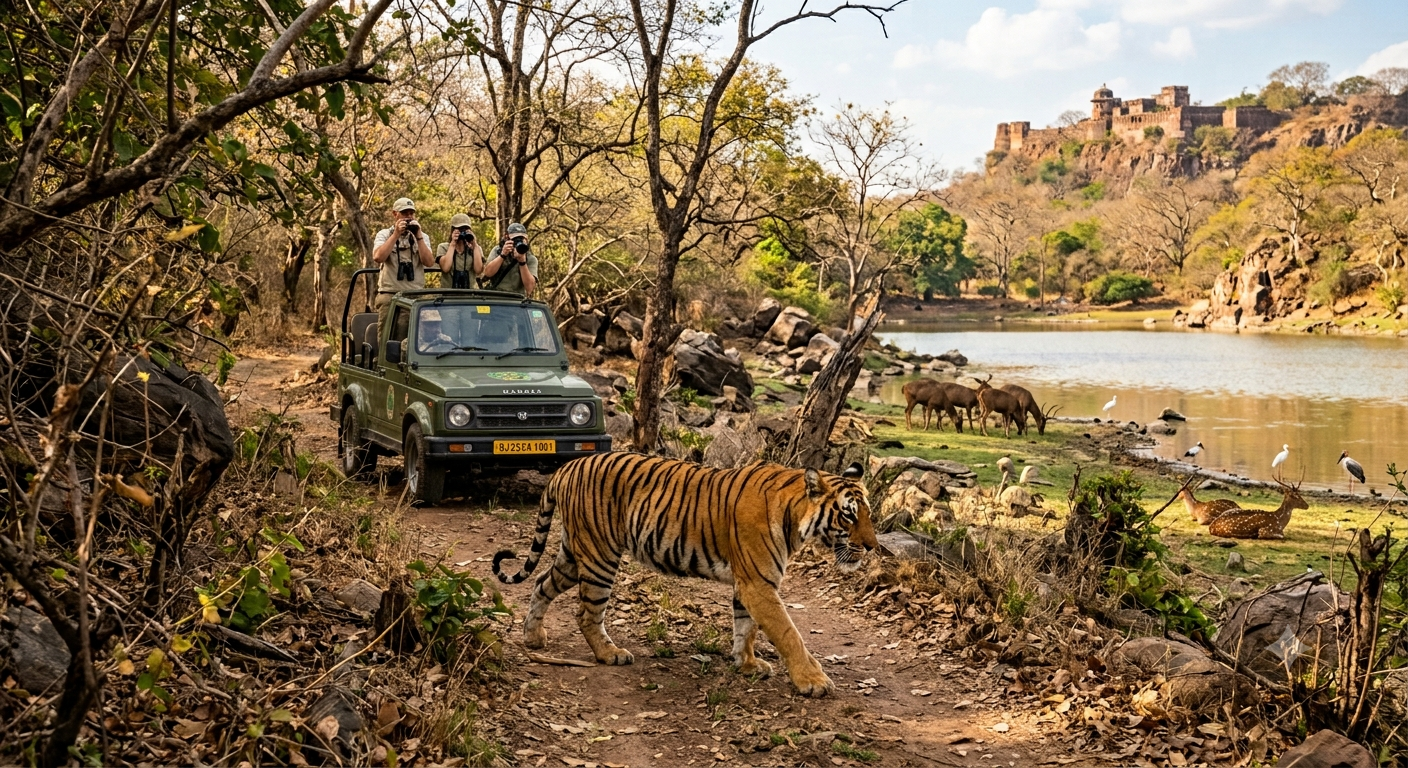
Realistic expectations:
- Sightings are never guaranteed.
- Several safaris in different zones improve your overall chances.
- Dry months (April–June) concentrate animals near water.
- Mornings are often quieter and more active, but afternoons produce plenty of sightings too.
- Seeing a tigress with cubs is a bonus, not a promise.
Beyond the tiger, Ranthambore is home to leopards (rarer), sloth bears, striped hyenas, jackals, caracals, marsh crocodiles, sambar, chital, nilgai, wild boar, langurs, and a rich list of resident and migratory birds. Some safaris go by without a tiger yet still deliver wonderful sightings.
Ranthambore Safari Zones and How to Choose One
The reserve is divided into 10 safari zones. Zones 1 to 5 are traditionally called the core zones, with Zones 6 to 10 as buffer zones. Zones 2, 3, 4 and 5 are widely considered strong for tigers, though tiger movement changes the picture season to season.
| Zone group | Character | Why choose it |
|---|---|---|
| Zones 1–5 (core) | Lakes, fort ruins, rocky valleys and grassland | Highest historic sighting frequency, but also the most demand |
| Zones 6–10 (buffer) | Quieter, more varied terrain | Easier to book, fewer vehicles, increasingly good sightings, especially in Zone 6 |
Commonly cited highlights: Zone 3 for its lakes and fort setting, Zone 4 for open terrain and sloth bear sightings, and Zone 5 for rugged scenery.
Can you choose your zone?
In practice, zones are generally allotted by the forest department around the time of your safari rather than guaranteed at booking, and sources and operators differ on how much choice is possible. Do not build your trip around a single zone. Instead:
- Book multiple safaris over different shifts.
- Do not skip buffer zones if core zones are full.
- Trust your guide’s reading of recent tiger movement.
- Remember that price is the same regardless of zone.
For background on how the reserve came to be, see the history of Ranthambhore.
Ranthambore Safari Ticket Prices and Other Expenses
A safari price bundles three charges: park entry, vehicle hire and the naturalist guide. Rates differ by nationality and vehicle, and the forest department revises them periodically, so published figures vary between sources. Treat the table as indicative and confirm on the official portal before paying.
| Safari type | Indian nationals (per seat) | Foreign nationals (per seat) |
|---|---|---|
| Canter (20 seats) | Roughly ₹1,800–2,200 | Roughly ₹5,000–5,500 |
| Gypsy (6 seats) | Roughly ₹2,500–3,000 | Roughly ₹5,500–6,000 |
| Full Gypsy (private) | About six times the seat rate | About six times the seat rate |
Other costs to budget:
| Expense | Typical range |
|---|---|
| Video camera fee (non-professional) | Around ₹600 (Indian) / ₹900 (foreign) per camera |
| Still photography with phone or DSLR | Usually no extra charge |
| Ranthambore Fort | Separate ticket; not included in a safari permit |
| Budget stay | Roughly ₹1,500–3,500 per room per night |
| Mid-range resort | Roughly ₹4,000–9,000 per room per night |
| Luxury lodge | ₹20,000+ per night |
| Meals | ₹500–1,500 per person per day outside luxury lodges |
| Local transport | Varies by distance; hotel transfers are common |
Sample 3-day, 2-night ballpark (per person, Indian nationals, excluding travel to Sawai Madhopur):
- Budget: about ₹14,000–20,000 (four canter safaris, simple stay).
- Mid-range: about ₹22,000–33,000 (four Gypsy seats, resort stay).
- Luxury: ₹80,000 and above.
Foreign visitors should add the higher permit slab, which puts four safaris alone at roughly ₹20,000–24,000. If the forest department raises rates between booking and your visit, you may owe the difference at the gate, so carry some extra cash. For a deeper breakdown, read our Ranthambore entry fee guide.
How to Reach Ranthambore: Train, Road and Air
The park is about 11–14 km from Sawai Madhopur Junction, a station on the Delhi–Mumbai main rail line.
| Mode | Route | Approx. time | Notes |
|---|---|---|---|
| Train | Delhi to Sawai Madhopur | About 4.5–6 hours | Several fast trains daily; the easiest option |
| Train | Jaipur to Sawai Madhopur | About 2–2.5 hours | Frequent services |
| Train | Mumbai to Sawai Madhopur | About 12–14 hours | Direct trains on the main line |
| Road | Jaipur to Ranthambore | About 160–180 km, 3–3.5 hours | Good highway, easy taxi route |
| Road | Delhi to Ranthambore | About 380–400 km, 6.5–7.5 hours | Better as a drive-in, drive-out trip |
| Air | Jaipur International Airport | About 3–3.5 hours onward by road | Nearest major airport; Sawai Madhopur has no airport |
Sawai Madhopur is also reachable by rail from Kota, roughly 100 km away. Once in town, resorts and operators commonly arrange pickups, and local taxis and autos cover the short ride to your hotel.
Where to Stay in Ranthambore
Most lodges cluster along the road between Sawai Madhopur and the park gates, which saves travel time on early mornings.
- Luxury: Lodges such as Aman-i-Khás, The Oberoi Vanyavilás and Taj Sawai Madhopur Lodge offer tented or heritage-style stays, private naturalists and in-house safari arrangements.
- Mid-range: Wildlife resorts with pools, restaurants and organised safari transfers, which suit families and couples.
- Budget: Guesthouses and simple hotels in Sawai Madhopur town, good for travellers who care more about the safari than the room.
How to choose: Prioritise proximity to the park gates, early breakfast or packed-meal service, safari pickup arrangements and clear cancellation terms. Browse our curated Ranthambore hotels and stays to compare options.
Other Attractions Near Ranthambore
- Ranthambore Fort: A hilltop fort within the reserve with origins in the 10th century, and part of the Hill Forts of Rajasthan UNESCO World Heritage listing (2013). It has gates, step-wells, palaces and sweeping views over forest and lakes. Its entry is separate from the safari permit.
- Trinetra Ganesh Temple: Inside the fort, widely known for devotees who send letters and wedding invitations here.
- Jogi Mahal and the lakes: Padam Talao, Raj Bagh and Malik Talao, seen from safari routes and a favourite setting for sightings.
- Surwal Lake: A quiet spot for birdwatching outside the safari zones.
- Rajiv Gandhi Regional Museum of Natural History: A good rainy-hour or midday stop near the town.
- Handicraft stops: Local craft centres sell textiles, block prints and souvenirs.
- Khandar Fort: A lesser-known fort for travellers with an extra day.
For travellers curious about the fort’s past, our post on the history of Ranthambhore is a useful read, and our photo gallery shows what to expect.
Safari Rules, Travel Tips and Packing Essentials
Rules to follow
- Stay seated in your vehicle and follow your guide’s directions.
- Do not feed, tease or call out to animals.
- Keep voices low and avoid loud music or sudden movement.
- Do not litter or leave plastic in the forest.
- Do not smoke or carry alcohol.
- Commercial filming and drones are not allowed without special permission.
- Carry the original government ID used when booking.
- Arrive early; late arrivals may lose their slot.
Practical tips
- Book at least a few weeks, ideally two to three months, ahead for peak dates.
- Spread your safaris across mornings and afternoons, and different zones if you can.
- Be patient: tigers may rest for long periods, so wait quietly rather than rushing on.
- Ask your guide about recent sightings, but do not push the driver to break rules.
- Keep a buffer day or shift in case of bad weather.
What to pack
- Earth-toned clothing (khaki, olive, brown); avoid bright colours.
- Winter: warm layers, a scarf, gloves and a cap for chilly open-jeep mornings.
- Summer: light cotton, a hat, sunglasses and sunscreen.
- Binoculars and a camera with a good zoom lens.
- Power bank, extra memory card and a dust cover.
- Water, light snacks and a basic first-aid kit.
- Original ID and some cash.
Common Mistakes Tourists Should Avoid
- Booking only one safari. It leaves everything to a single shift.
- Waiting too long to book. Core-zone slots sell out quickly.
- Assuming a higher price or a Gypsy guarantees a tiger. It does not.
- Using unverified agents. Check permit details before paying.
- Forgetting ID or using a different ID from the one in your booking.
- Wearing bright clothing or perfume.
- Skipping buffer zones. They can be excellent and far less crowded.
- Underpacking for winter mornings. Open jeeps are cold at sunrise.
- Overpacking the itinerary. Early mornings are tiring, so leave rest time.
- Treating the fort as part of the safari. It needs its own time and ticket.
Frequently Asked Questions
How many days are sufficient for Ranthambore?
Two nights and three days is sufficient for most travellers, giving three to four safaris. One day works as a taster; four days suit photographers and relaxed travellers.
Is one day enough for Ranthambore?
One day is enough for one or two safaris and a quick fort visit, but your tiger-sighting chance depends heavily on luck. Two nights is far more reliable.
How many safaris should I book?
At least three, ideally four, spread across different shifts and zones.
What is the best time to visit Ranthambore?
November to March for comfort; April to June for the best sighting odds and high heat. The core zones are closed July to September.
Is a tiger sighting guaranteed?
No. Ranthambore is among the best places in India to see tigers, but they are wild animals and no operator can guarantee a sighting.
How far in advance should I book?
Bookings open 90 days ahead. For peak months and core zones, book as soon as your date opens.
Which zone is best for tigers?
Zones 2 to 5 have historically been popular, and Zone 6 is rising. Zones are generally allotted by the forest department, so book several safaris instead of relying on one.
Gypsy or canter: which is better?
A Gypsy is more intimate and manoeuvrable; a canter is cheaper and suits larger groups. Neither guarantees a sighting.
How long is a safari?
About 3 to 3.5 hours per shift, morning or afternoon.
How much does a safari cost?
Indicatively, Indian nationals pay roughly ₹1,800–2,500 per seat and foreign nationals roughly ₹5,000–6,000 per seat, depending on vehicle and revisions. Confirm current rates on the official portal.
Can I book on arrival?
Only through the limited last-minute window, at a premium and with no certainty. Advance booking is far safer.
Do I need ID to enter the park?
Yes. Every traveller needs a government ID, and it must match the booking.
Is Ranthambore suitable for children?
Yes. Children are allowed, and the roughly three-and-a-half-hour safari is manageable with snacks and water. Carry age proof, since small children may be free and older children usually pay a full seat.
How do I reach Ranthambore?
By train to Sawai Madhopur Junction (the easiest route), by road from Jaipur or Delhi, or by air to Jaipur and onward by road.
Is Ranthambore Fort included in the safari ticket?
No. It has separate access rules and tickets.
Final Verdict: How Many Days Should You Plan?
- Short on time? One to two days gives you a taste of Ranthambore.
- Want the best value? Three days and two nights, with four safaris, is the sweet spot.
- Photographer or family? Four days gives breathing room, more light and a stronger chance at special sightings.
Plan early, spread your safaris, keep expectations realistic, and the forest will do the rest.
Related Reading
- Ranthambore Safari Booking: The Complete Guide
- What Is the Entry Fee for Ranthambore?
- Distance Between Ranthambore and Jaipur
- Gypsy Safari · Canter Safari · Full Day Safari
- Hotels and Stays Near Ranthambore
- The History of Ranthambhore
- International Tiger Day and Ranthambhore
- About Ranthambhore · Photo Gallery · Ranthambhore Blog
- Ranthambhore Park homepage